
Housing, Density, and the Political Will to Deliver
By Mary Carr Lee, Mayors Innovation Project
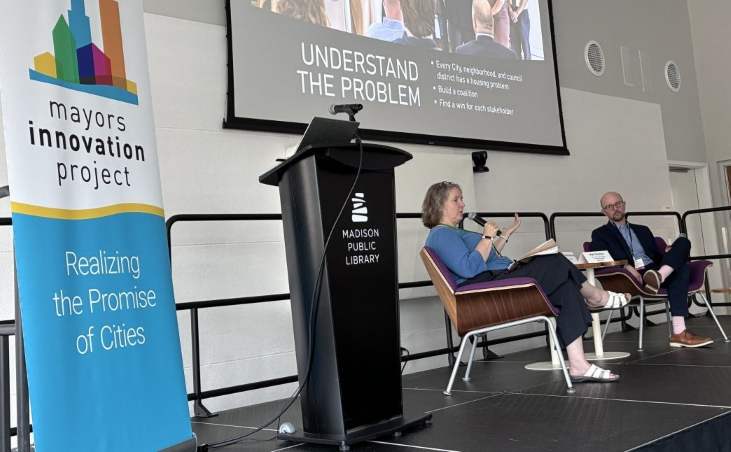
Madison’s housing landscape is changing quickly—and not by accident. At MIP’s 2026 Summer Conference in Madison, WI, Mayor Satya Rhodes-Conway and Matt Wachter, the city’s Director of Planning, Community, and Economic Development, detailed how Madison is modernizing development processes, messaging and moving significant zoning reform, and tackling historic underbuilding to expand housing diversity and affordability. They highlighted the political will, deliberate technical planning, and community engagement needed to transform the city’s housing future.
Over the past ten years, Madison has added 26,000 new homes, including 4,000 affordable units, a pace that places the city among the most active builders in the Midwest. Vacancy rates went from 2% to 6%. Both leaders emphasized that this progress is intentional — the result of coordinated planning, zoning reform, financial innovation, and persistent public engagement.
A Citywide Approach to Planning
Wachter opened the session by describing how Madison has shifted from neighborhood-specific planning to a citywide framework. “We used to plan one neighborhood at a time,” he explained. “But that approach wasn’t keeping up with the pace of change. Now we’re planning the entire city through twelve defined areas so we can think long-term and holistically.”
This broader approach has strengthened community outreach and created more predictable expectations for residents and developers. Wachter noted that the citywide model helps staff anticipate growth patterns, infrastructure needs, and zoning updates in a coordinated way. “People want to know what the future looks like,” he said. “This gives them a clearer picture.”
Mayor Rhodes-Conway echoed the importance of planning at scale. “Madison is growing fast,” she said. “We must be proactive, not reactive. That means planning for the city we’re becoming, not just the city we’ve been.”
Zoning Reform: Making Room for More Homes
One of the most significant changes Madison has made is modernizing its zoning code to allow gentle density — small-scale housing types that fit into existing neighborhoods. Wachter highlighted several reforms, including allowing for accessory dwelling units, duplexes, and flexible lot configurations. “We’ve removed a lot of the veto points that used to stall projects,” he said. “If we want more housing, we have to make it legal to build more housing.”
The city has also introduced flag lots and expanded opportunities for small multifamily buildings. Wachter explained that these changes help unlock underused parcels and create more options for residents. “Not every solution is a big apartment building,” he said. “Sometimes it’s one or two units that make a difference.”
Mayor Rhodes-Conway acknowledged the challenges inherent in these reforms, but emphasized that the status quo is not an acceptable response. “Zoning changes are hard,” she said. “People get nervous about what might happen in their neighborhood. But we can’t solve our housing shortage without making room for more homes. Every neighborhood is going to need to accept a little more density.”
Innovative Housing Tools and Financial Strategies
Madison’s housing strategy extends beyond zoning. Wachter outlined a suite of financial tools designed to support both affordable housing and homeownership. “We’ve been very aggressive with Section 42 tax credits,” he said. “We pair federal dollars with city funds and private investment to make projects viable — and to keep them affordable for the long term.” He noted that Madison often negotiates affordability periods that exceed federal requirements. “We’re not interested in short-term affordability,” he said. “We want units that stay affordable for decades.”
The City acquires land to prioritize affordable housing, economic development, and land preservation through its robust land banking policy and program. Madison offers several programs to promote homeownership – down payment assistance, homebuyer education, reverse mortgage support and rehab loans for individuals, but also funds construction of new ownership opportunities through innovative programs like the Housing Forward RFP, which invites creative proposals for affordable housing that doesn’t use tax credits. “We’re trying to meet people where they are,” Wachter said. “Not everyone needs the same kind of help.”
Infrastructure: The Hidden Challenge
Housing development depends on infrastructure — water, sewer, roads, and utilities — and Wachter acknowledged that older areas of Madison pose challenges. “Infrastructure is expensive,” he said. “And in some parts of the city, it’s aging. We must be smart about predicting where upgrades are needed.” He described the city’s efforts to use predictive planning and experimental financing to stay ahead of infrastructure demands. “We’re trying to model future needs instead of reacting to problems after they happen,” he said.
Mayor Rhodes-Conway added that infrastructure concerns often surface in public conversations about housing. “People worry that new development will strain the system,” she said. “We have to show them that we’re planning for that — and that growth helps pay for the improvements we need.”
Political Will and Community Trust
The mayor spoke candidly about the political dynamics surrounding housing. “Madison’s politics have shifted,” she said. “There’s more support for housing now, but that didn’t happen by accident. We’ve worked hard to build a coalition around this.”
She described the importance of endorsing pro-housing candidates, appointing commissioners who understand development, and using political capital to advance zoning changes and process improvements. “You have to be stubborn,” she said. “Housing takes persistence. You can’t give up when people push back.”
This multifaceted approach recognizes that housing reform is not just about policy — it’s about people. Wachter and Rhodes-Conway discussed the strain on staff capacity and the importance of bringing both elected officials and city employees along in the process. “We’ve made big improvements to streamline development,” Wachter said. “Aligning planning, zoning, and financial incentives makes the process more predictable.”
The mayor emphasized the need for clear communication with the public. “People deserve to know what’s happening and why,” she said. “When we explain our goals, we build trust — and trust is essential for housing.”
Wachter agreed, noting that messaging is critical. “If people understand what we’re trying to do, they’re more likely to support it,” he said. “We have to communicate clearly and consistently.” The city has worked to message proposed changes with plain language and to incorporate visuals and responses to frequently asked questions into its communications on Housing Forward proposals, for example.
A Vision for Madison’s Future
The discussion closed with a shared message: Madison’s housing challenges are significant, but the city is tackling them with creativity, coordination, and determination. Wachter summed up the city’s approach succinctly: “We’re planning smarter, building more, and thinking long-term. That’s how we meet the needs of our residents.”
“We’re building the Madison of the future,” Mayor Rhodes-Conway said. “And that means making sure people can afford to live here.”
To access the briefing book and slide presentations from this panel, please visit our Summer 2026 Meeting webpage.