
Under Pressure: How the Unique Challenges Faced by Women Mayors Undermine Democratic Governance
Over the course of our 20 year history as an organization, we’ve heard countless stories from women mayors that inspired us to study and document the challenges and systemic barriers that mayors face while campaigning and in office. With support from the Barbara Lee Family Foundation, we launched a research project in the spring of 2024 aimed at better understanding the experiences of women as they campaign for and govern as mayor.
Through this work, we hope to raise awareness about the challenges women mayors face, demonstrate a need for additional research and broader dialogue on their impact, and inspire action to support women in executive leadership.
Executive Summary
This report, produced by the Mayors Innovation Project’s Women Mayors Network, explores the unique challenges faced by women mayors across the United States through a national survey and in-depth interviews. The findings reveal that women mayors reported more frequent and severe harassment than their male counterparts, both during campaigns and while in office. They also faced disproportionate criticism related to their appearance, competence, emotional state, and family responsibilities, often navigating a “double bind”—at times being perceived as too weak and at other times too strong. These experiences not only impact the personal well-being of women mayors but require them to devote extra time and energy refocusing attention to their work.

Despite these challenges, the report highlights the resilience and determination of women in mayoral roles and the solutions to address the barriers that women face. Many women mayors continue to serve their communities with distinction, often relying on peer support networks and professional development opportunities. However, resilience alone is not a sustainable solution. Systemic changes—including equitable pay, improved safety measures, supportive staffing, and inclusive policies—are needed to reduce barriers and foster a more representative and effective local government. By addressing these issues, cities can better support women in leadership and strengthen democratic governance at the local level.
Key Themes and Stark Statistics
![Graphic of a quote reading, “[People threatened] to kill my husband . . . [they said] there’s too many rats in [my city], so [we’ll] give the rats the poison and . . . poison your [children]," next to a cartoon woman in a green suit.](https://mayorsinnovation.wisc.edu/wp-content/uploads/sites/568/2025/09/Threats-to-Family.png)
Threats to Family
While campaigning, 29% of women mayors reported threats and harassment to their family compared to 19% of men. Nearly twice (39%) as many women reported threats and harassment to their family compared to men (20%).
![Graphic of a quote reading, “I used to say, meeting adjourned. Now I have to ask [the council] for amotion to adjourn the meeting . . . they have changed quite a few things and taken the power away from the mayor as much as they could,” next to a cartoon woman wearing a yellow suit holding a book in her right hand.](https://mayorsinnovation.wisc.edu/wp-content/uploads/sites/568/2025/10/Challenges-to-Authority.png)
Challenges to Authority
As mayor, 19% of women mayors reported experiencing attempts to limit their authority compared to 16% of men. Nine percent of women mayors reported experiencing refusal of city staff or subordinates to perform the basic duties of their job compared to 6% of men, and 11% of women compared to 6% of men reported experiencing attempts by council or staff to scrutinize or limit their travel budget or schedule.
![Graphic of a quote reading, "[I was] physically intimidated at the doors all the time, people stepping out, people taking literature and then ripping it up in [my] face and throwing it at [me], that sort of stuff,” next to a cartoon woman in a yellow blazer with a blue briefcase.](https://mayorsinnovation.wisc.edu/wp-content/uploads/sites/568/2025/09/Threats-and-Harassment.png)
Threats and Harassment
A shocking 84% of women mayors reported experiencing harassment while on the campaign trail, compared to 64% of men. In office, 25% of women mayors reported being harassed at least three times a month, more than double the rate for men (10%).
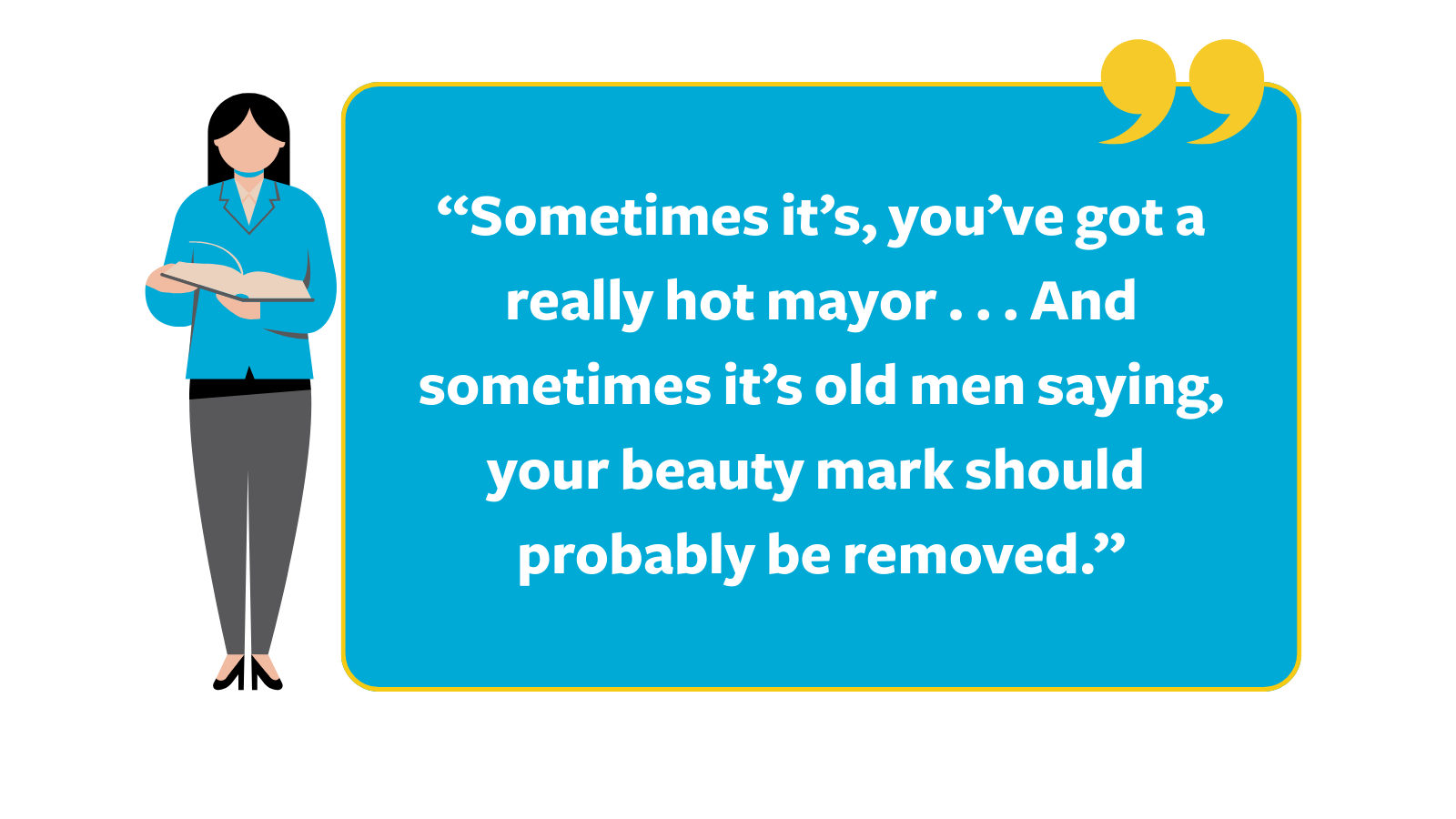
Criticism of Physical Appearance
Women mayors reported experiencing such criticism on the campaign trail and in office at over double the rate as men, with 52% of women reporting experiencing criticism while campaigning compared to 25% of men. As mayor, 43% of women reported experiencing criticism of their appearance compared to 18% of men.
![Graphic of quote that reads, “I had a guy who sent me an email . . . basically inferring that he’d like to [commit sexual violence against] me . . . it was a series of like 40 emails . . . filled with a lot of sexual violence," next to a cartoon woman in a green blazer holding a book.](https://mayorsinnovation.wisc.edu/wp-content/uploads/sites/568/2025/09/Sexual-Harassmentt.png)
Sexual Harassment
Women reported experiencing sexual harassment significantly more than their male peers. While campaigning, 41% of women reported experiencing sexual harassment, compared to 6% of men. While governing, 40% of women reported experiencing sexual harassment compared to 5% of men.
![Graphic of a quote reading, “I had [an advanced degree and experience in local government, yet] . . . my experience was pooh-poohed in certain circles, like is she really ready to lead the city," next to a cartoon white woman wearing a yellow suit holding a piece of paper.](https://mayorsinnovation.wisc.edu/wp-content/uploads/sites/568/2025/09/Ability-to-do-the-Job.png)
Questions about ability to do the job
On the campaign trail, 19% of women experienced questions about their ability to do the job related to their identity compared to 10% of men. In office, 20% of women mayors reported experiencing questions about their ability to do the job related to their identity while governing compared to just 9% of men, implying that their gender, marital status, or family composition somehow made them unfit to serve.
Implications for Democracy
These barriers make it difficult for women to get elected, create hostile environments once they are in office, and ultimately discourage them from staying in their positions or seeking higher office. Our data indicates that the persistent underrepresentation of women in the role of the mayor is not due to a lack of qualification but rather to systemic barriers, which result in enormous personal costs to women. Barriers include a lack of access to financial networks and political patronage, negative stereotypes in media, online harassment, threats to physical safety, and a lack of traditional recruitment methods targeted towards women. These barriers cost women time on the job, time with their families, income that they would otherwise earn at other jobs, personal privacy, security, and their mental and physical health. Once in office, both legal and cultural challenges to women’s authority inhibits their ability to lead at their full capacity.
But this is not just a problem for women.
This is a problem for everyone—underrepresentation of women in elected office is a problem for our democracy. As barriers discourage women from running or push women out of office, communities lose out on qualified leaders. Research from the United Nations confirms that when women lead, they propose and pass more equitable policies and services that focus on social issues such as healthcare, education, and community development, leading to a higher quality of life for all residents. Furthermore, studies consistently show that women are more likely to work across party lines and lead collaboratively. The good news is that actively supporting women in public office can strengthen our democracy. Many resources—time, energy, and a considerable amount of money—are spent reinforcing systemic barriers to women’s political leadership. The data and experiences shared in this report and across a number of other studies demonstrates that investing resources to support women in government is a powerful way to boost representation, advance policies that improve people’s lives, and bolster a democracy that is flagging.
Nevertheless, She Persisted
Despite the overwhelming systemic and individual barriers that women mayors face, female survey respondents reported that they would encourage others to run for mayor at nearly identical rates to male respondents—79% of women and 80% of men said they would encourage others to run for office.
Solutions
Women have found ways to succeed in the role and make progress in the cities they serve, and they are eager to share these tools and strategies with current and upcoming women mayors. Many women mayors expressed that they wished someone had been honest about the reality of all that comes with being a woman in the office of the mayor and how they could prepare for it.
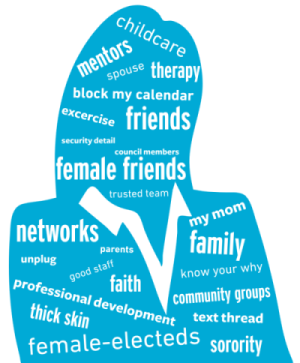
In interviews and our survey, we asked women mayors what strategies, tools, resources, and practices have helped support them. Answers ranged from family support to therapy to faith communities to a daily exercise regimen.
While having support from fellow female electeds is wonderful, asking women to be resilient and rely on each other is neither an adequate nor a sustainable response to the barriers they face each day. There are tangible policy responses that can be put in place to lessen the burden placed on women in elected office. For the job to be more accessible to women, women mayors shared that they needed more resources, including increased pay and benefits, childcare, security, funding for professional development and networking opportunities, and funding for supportive staff.
What can local governments do?
There is a pervasive misperception of mayors taking advantage of travel opportunities related to training and professional development, often referred to as “vacations” or “junkets,” borne out by little data. Professional conferences and training programs for local elected leaders are a great opportunity to share city successes, learn from peers, and bring back resources and ideas to your city.
A number of women that we interviewed called out having good, supportive staff as key to feeling supported professionally. We recommend broad support for mayors having staff dedicated to them.
Create and reimagine opportunities for constituents, especially women and people of color, that demystify the process and promote civic engagement. Examples include Civic Academies and participatory budgeting processes. The majority of the public does not understand what local governments—including the mayor—actually do and have authority over. Educating the public about civic processes and roles can help build trust in government and develop new pathways for people to engage with their local government.
Anti-harassment policies and procedures, paid leave policies,
and access to childcare services are key for making the role of the mayor accessible to women and people of color.
Dedicate time and space to city council retreats and other opportunities to encourage collaborative, respectful communication. It’s hard to recruit good candidates when your elected body is—or is perceived as—divisive and combative. Council retreats offer an opportunity for the elected body to come together to focus on process over policy, to get to know one another as human beings, and to create norms and standards for conduct in political office that benefit the wider community.
While strong, full time mayors and mayors in larger cities tend to receive higher pay, many of the women we spoke with—regardless of form of government or city size—are not paid anything close to a living wage. Local governments should undertake a pay equity study, which analyzes job duties alongside qualifications, experience, and pay to assess wage gaps based on characteristics like gender and race. Higher and fairer wages increase access to local political office, attract talent, and help reduce disproportionate challenges in running for and serving in office identified here, such as financial barriers and unpaid caregiving responsibilities.
If allowed in your state, consider adopting or enacting
Ranked Choice Voting (RCV). RCV allows voters to rank
candidates in order of preference; if one candidate receives more than half of the initial ballots, they win. If not, the candidate with the fewest votes is eliminated and the voters who picked that candidate as their first choice have their second choice counted. This continues until a candidate exceeds the 50 percent threshold. Data in localities using RCV have shown an increase in women and people of color running in—and winning—elections. A report by RepresentWomen found that cities with RCV systems elect more women than cities with traditional plurality voting systems, suggesting that RCV is an effective way to encourage fairer elections with more representative and equitable outcomes.
What can you do?
Many mayors we spoke to shared that when they pursued efforts to increase security of their home, office, or themselves, they were met with pushback of the actions being excessive, combative, or self-serving. Many have resorted to using their own money to litigate cases related to their position, hire personal security, or increase their security—necessitated by their role—at home or at work. In light of the many instances of physical and psychological threats, harassment, and actions documented here and in other research (and the media) recently, it’s critical to build public and media support for reasonable requests for safety-related staffing and infrastructure in a way that does not hinder the democratic process.
Members of the public and the media should undergo implicit bias training to confront their own unconscious biases, which everyone has. Related biases include not just obvious references to gender and race, but also to family structure, marital status, and appearance. The media should focus exclusively on qualifications and impact—there is simply no reason for news stories to reference a mayor or mayoral candidate’s appearance, clothing, or family structure.
On social media, in mainstream media, in public spaces, equip yourself with the skills to identify bias and to challenge it. This is especially important for those with some form of implicit power, influence, and visibility: others in elected office—especially white men, the media, businesses owners, etc.
Attend council meetings and budget hearings, inquire about civic engagement opportunities, serve on a committee, understand the different roles and powers of your local government, and/or consider running for local office. Local government is the truest and most intimate form of local democracy, and everyone benefits from increased engagement and understanding.
News and Social Media
In the News
-

Former Minneapolis Mayor Betsy Hodges shares ‘startling’ data on harassment faced by women mayors
A new poll from the national group Mayor’s Innovation Project shows that female mayors face higher rates of harassment and violence than their male counterparts. Former Minneapolis Mayor Betsy Hodges helped to develop and…
-
How America’s female mayors lead in the face of adversity
Former Minneapolis Mayor Betsy Hodges joined “The Final 5” to discuss a new study from the Women Mayors Network showing women mayors face substantially more harassment than their male counterparts. From threats…
-
Mayor Chasity Wells-Armstrong Speaks to the Lightning Strike Talk Radio Show
Mayor Chasity Wells-Armstrong spoke with Dr. Sheila White on Chicago’s Lightning Strike Talk Radio Show, highlighting her work with the Women Mayors Network (WMN) to carry out their recent study on the…
-
Survey shows sharp gender gap in political harassment
Female mayors experience political violence at a much higher rate than their male counterparts, according to the results of a new study conducted by the Mayors Innovation Project.