
All Publications
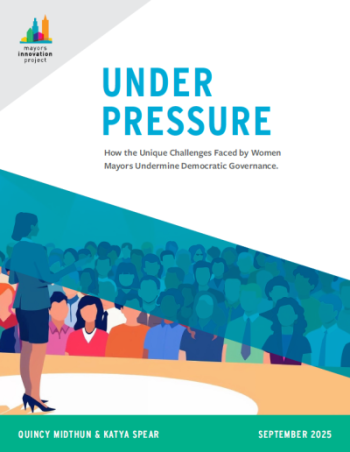
Under Pressure: How the Unique Challenges Faced by Women Mayors Undermine Democratic Governance
Under Pressure: How the Unique Challenges Faced by Women Mayors Undermine Democratic Governance.
This report, produced by the Mayors Innovation Project’s Women Mayors Network, explores the unique challenges faced by women mayors across the United States through a national survey and in-depth interviews. The findings reveal that women mayors reported more frequent and severe harassment than their male counterparts, both during campaigns and while in office. They also faced disproportionate criticism related to their appearance, competence, emotional state, and family responsibilities, often navigating a “double bind”—at times being perceived as too weak and at other times too strong. These experiences not only impact the personal well-being of women mayors but require them to devote extra time and energy refocusing attention to their work.
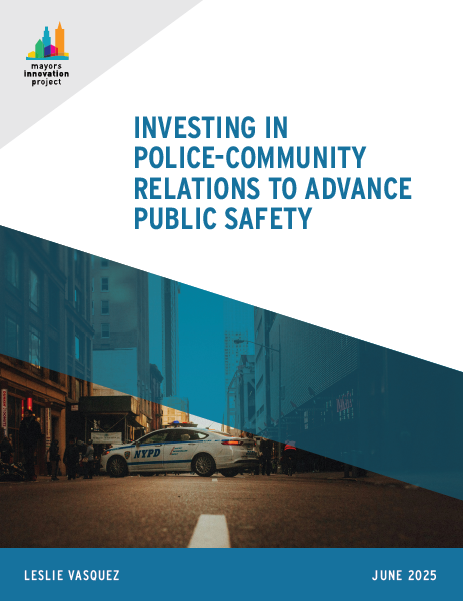
Investing in Police-Community Relations to Advance Public Safety
Investing in Police-Community Relations to Advance Public Safety.
Ensuring public safety is the first task of government. But since our country’s founding, the behavior of police in carrying out this role has been a perennial point of debate, social contest, and often violence. In the wake of the widely publicized police killing of George Floyd in Minneapolis in 2020—and in response to years of frustration with the effectiveness of police, jails, and prisons in enhancing public safety—we look at the many ways cities across the country are rethinking how they allocate police resources to respond to crime.
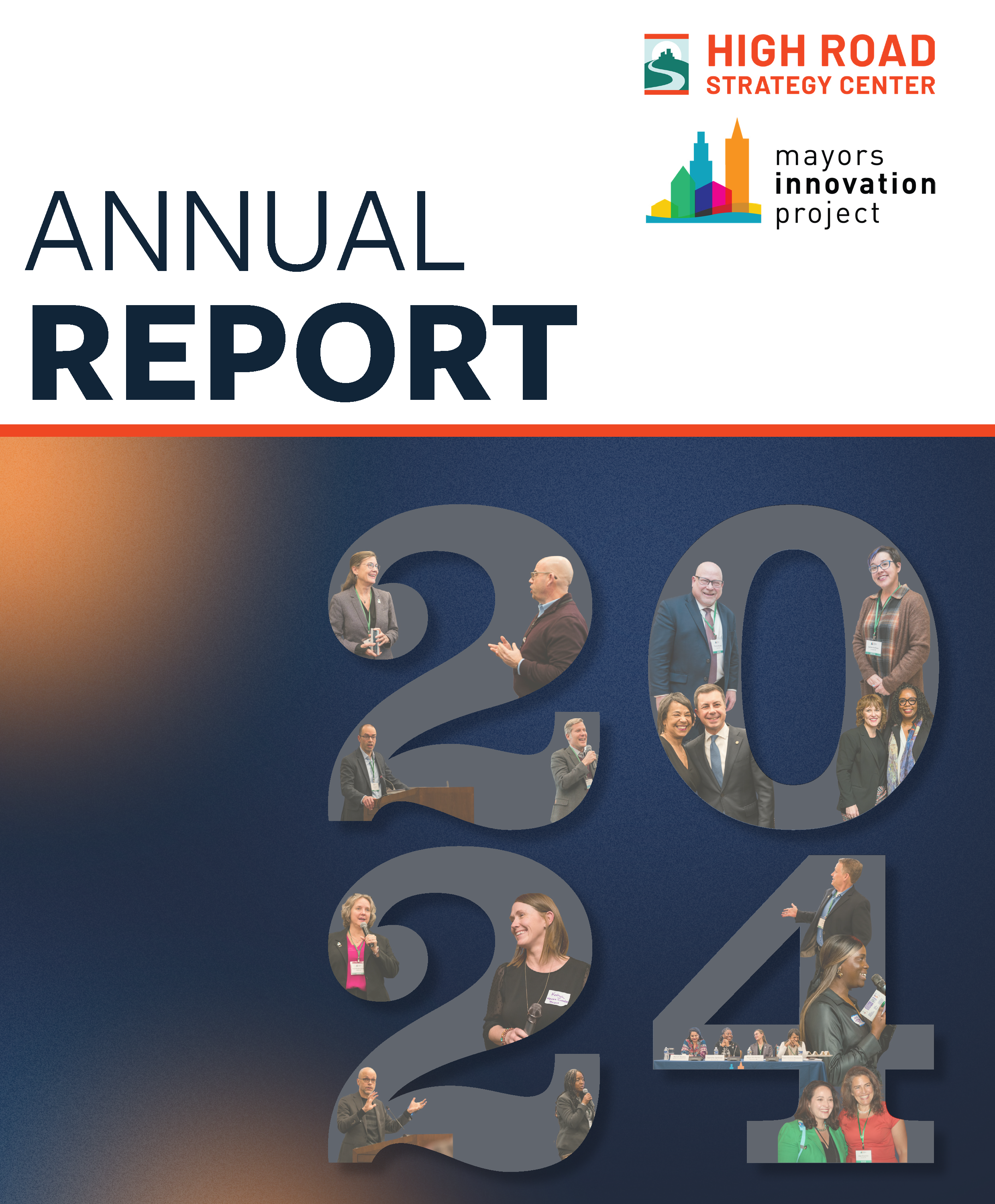
2024 Year In Review
This publication highlights the key projects, innovative policies and programs, and meaningful partnerships that contributed to our progress in 2024. From panels on transformative placemaking and violence prevention to tours of Knoxville’s urban wilderness to researching the barriers mayors face while campaigning and governing—we’re proud of the impact we’ve made and grateful for all of the mayors, city staff, sponsors, and partners that have supported our work.
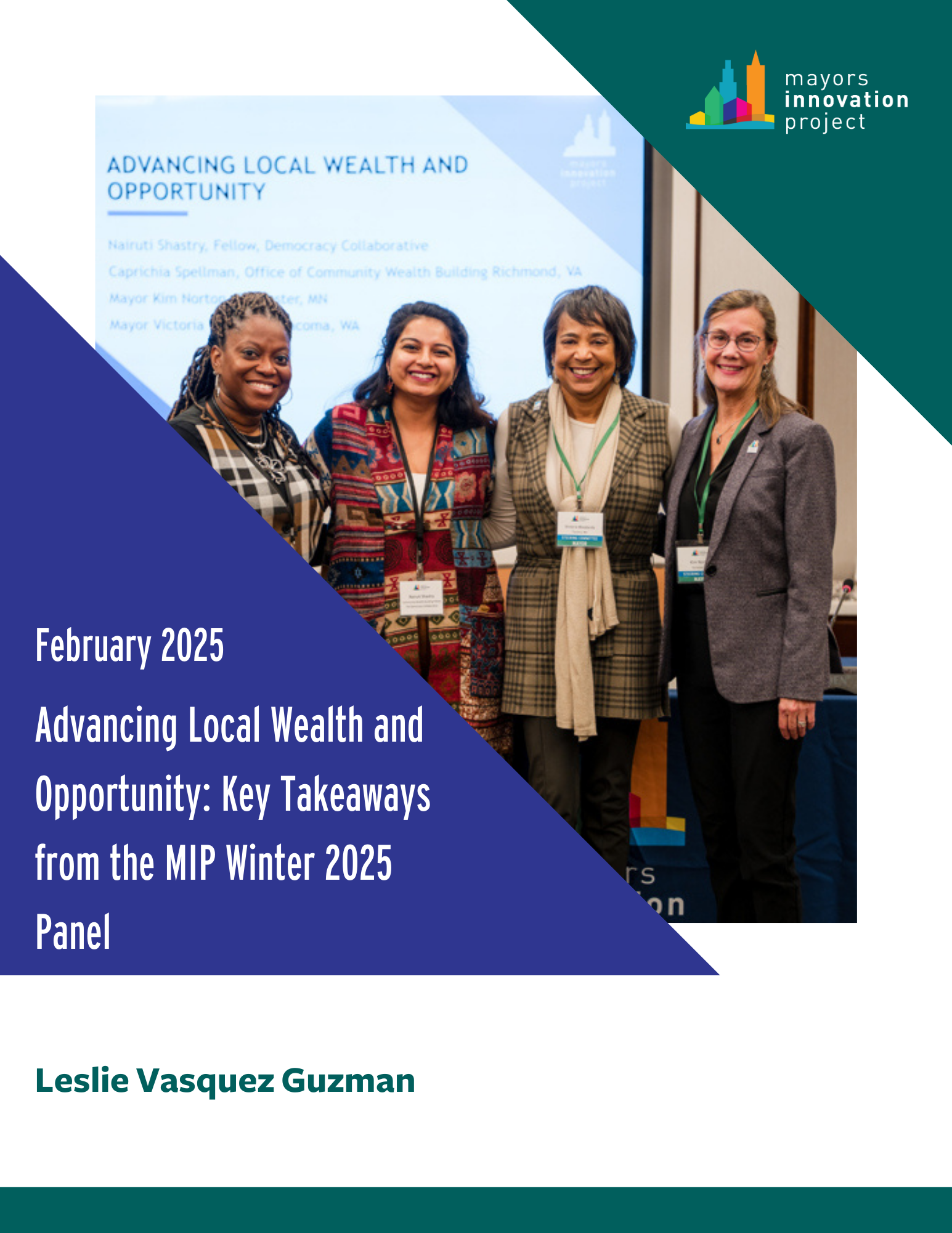
Advancing Local Wealth and Opportunity: Key Takeaways from the MIP W25 Panel
Advancing Local Wealth and Opportunity: Key Takeaways from the MIP W25 Panel.
Wealth inequality in the United States has reached unprecedented levels, leaving millions of Americans struggling to achieve economic stability, much less access economic mobility. This article summarizes the strategies shared by panelists at our Winter 2025 Meeting that mayors can use to advance local wealth and opportunity for residents.
Data, Financing, and Leadership Solutions for Flood Resilient Infrastructure
Data, Financing, and Leadership Solutions for Flood Resilient Infrastructure.
Climate change continues to pose unprecedented challenges for cities, and the 2024 hurricane season reminded us that flood resilient infrastructure is critical—and increasingly complicated to fund, implement, and manage. This article is a summary of the data, financing, and leadership tools that mayors need to plan for and implement projects to help their cities withstand and recover quickly from floods.
Good Ideas for Cities: Expanding Broadband Infrastructure and Internet Access
Good Ideas for Cities: Expanding Broadband Infrastructure and Internet Access.
High-speed internet is a necessity in everyday life for all Americans, yet many across the country lack access to affordable, reliable internet service. Less than fifty percent of Americans have access to fiber-optic broadband, the fastest and most reliable form of connection. This article shares the innovative measures cities have used to bring broadband to their communities.
Good Ideas for Cities: Wage Theft
Good Ideas for Cities: Wage Theft.
Across the country, workers in many industries face wage theft in one form or another. When looking towards accountability, agencies at all levels are often impeded by state-level preemptive laws that prevent local governments from enacting ordinances that would guarantee fair labor practices and access to secure wages. Though many cities face this barrier, there are still a number of effective strategies that local leaders can implement to combat wage theft.
Leadership and Policy for Welcoming and Inclusive Communities
Leadership and Policy for Welcoming and Inclusive Communities.
As President Trump’s deportation plans begin to take shape, refugee and immigrant communities across the country face fear and uncertainty. This article shares five timely recommendations for what cities and local leaders can do to dispel fear and promote a culture of welcoming.
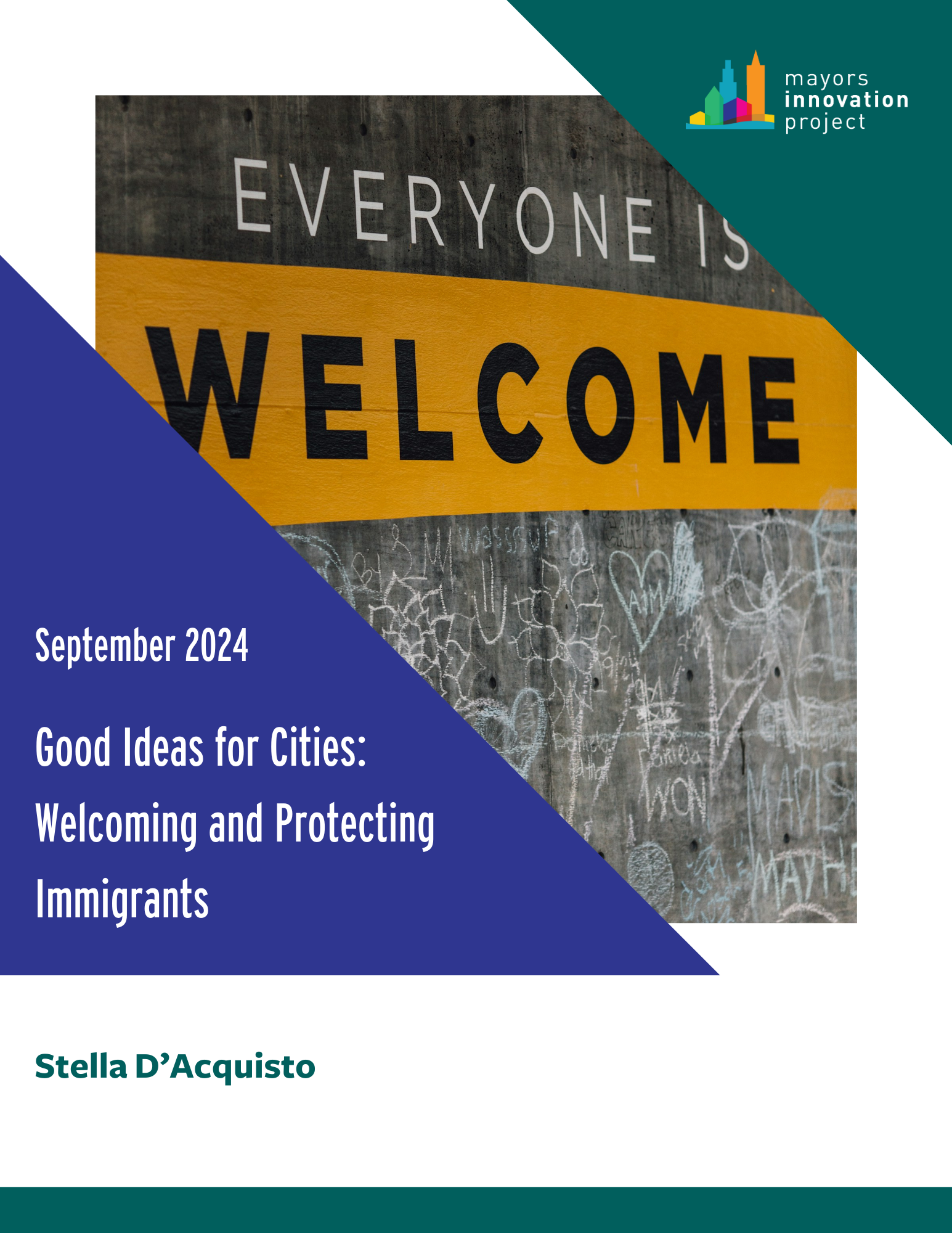
Good Ideas for Cities: Welcoming and Protecting Immigrants
Good Ideas for Cities: Welcoming and Protecting Immigrants.
In celebration of National Welcoming Week, a time to celebrate the diversity of communities and commit to making cities safe, welcoming, and inclusive places where everyone has the opportunity to thrive, this article provides best practices for local governments to support and protect immigrant communities.
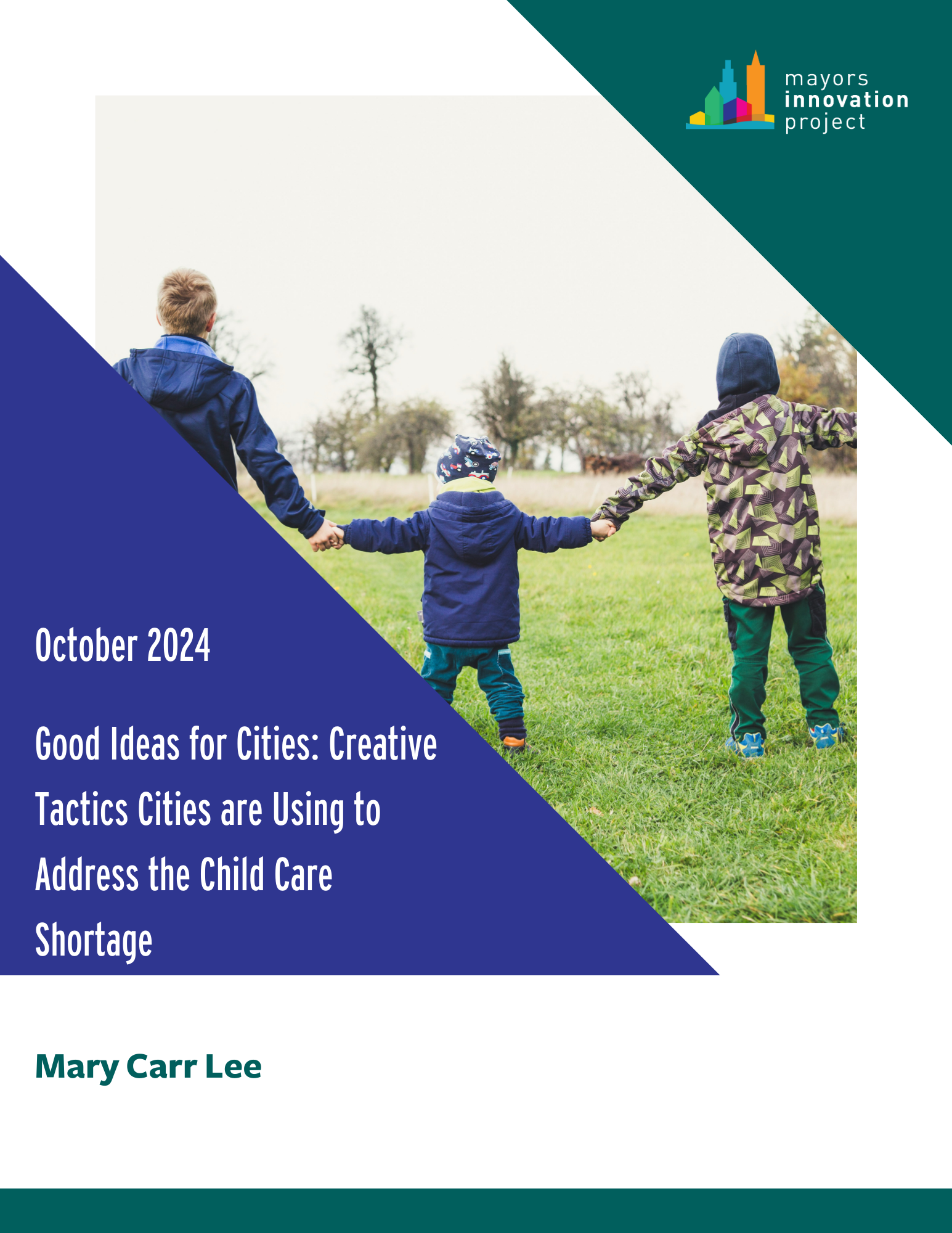
Good Ideas for Cities: Creative Tactics Cities are Using to Address the Child Care Shortage
Good Ideas for Cities: Creative Tactics Cities Are Using to Address the Child Care Shortage.
Child care in America has long had issues as costs are steep for providers and parents. In most US states, child care costs exceed the cost of college tuition. This article shares how cities and local governments are implementing innovative ways to make child care more affordable and accessible.
Maximizing Impact: Innovative Ways for City Leaders to Use Remaining ARPA Funding
Maximizing Impact: Innovative Ways for City Leaders to Use Remaining ARPA Funding.
The American Rescue Plan Act, signed into law by President Biden in spring 2021, was designed to provide direct funding to cities, towns, and villages to help them respond to and recover from the impacts of the COVID 19 pandemic. Since that time, cities have responded to this unprecedented direct funding with a slew of innovative programs designed to invest in long term resilience and to support sectors and communities particularly impacted by the pandemic. This article highlights some of the most innovative uses of ARPA funding, including the expansion of affordable housing, investments in digital equity, and workforce training.
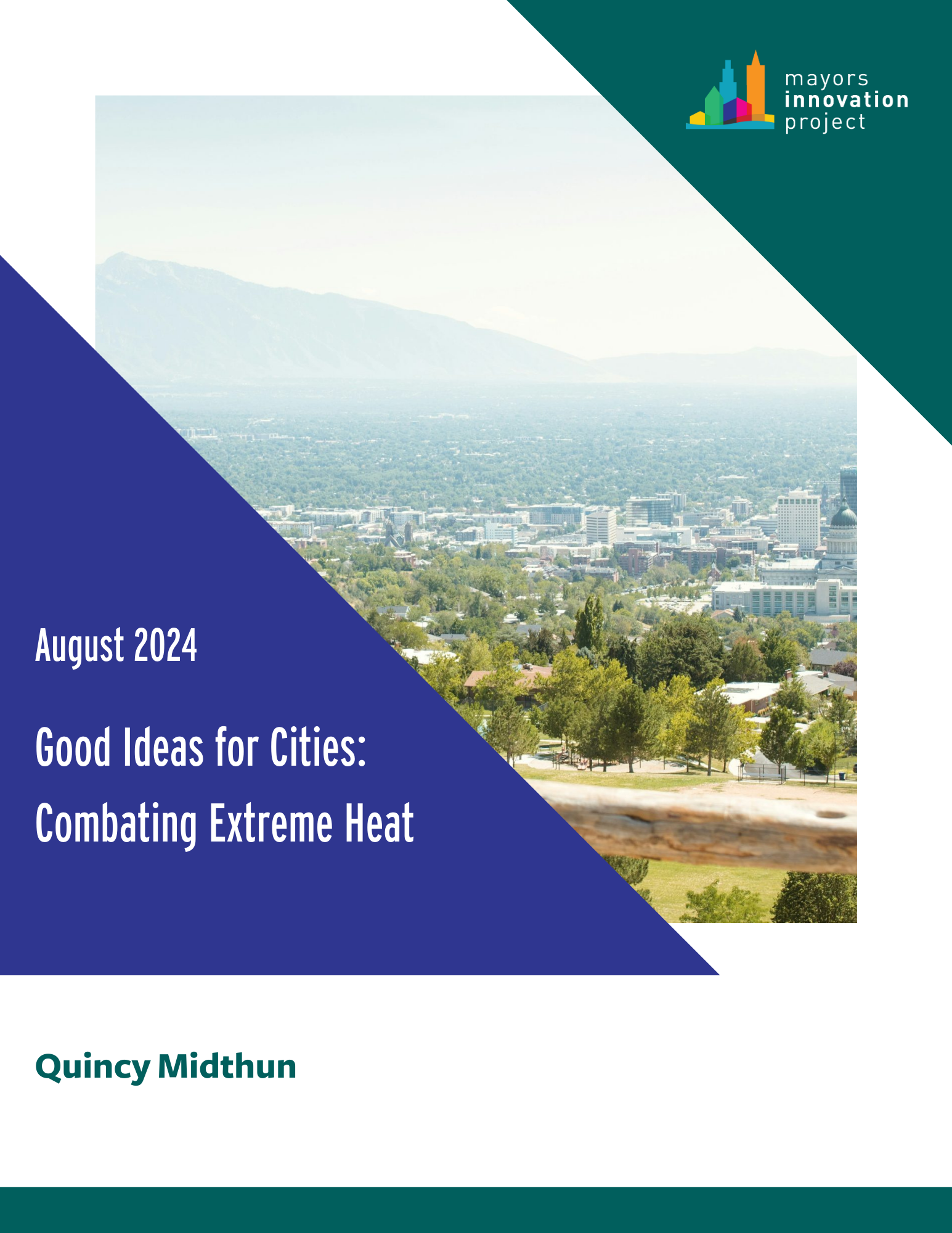
Good Ideas for Cities: Combating Extreme Heat
Good Ideas for Cities: Combating Extreme Heat.
The summer of 2024 was one of the hottest on record, and cities across the country are feeling the heat. Hot days are becoming hotter and more frequent. Yet, cities are working to combat heat in innovative ways. From Phoenix’s cool pavement to Cleveland’s Community Forestry Corps Program, this article highlights how cities are taking action to beat the heat and create cooler, safer, more sustainable cities.
Mayors Institute on Pedestrian Safety 2024 Report
Mayors Institute on Pedestrian Safety 2024 Report.
In partnership with AARP Livable Communities and Smart Growth America, the Mayors Innovation Project held its second annual cohort of the Mayors Institute on Pedestrian Safety (MIPS).
Mayors Institute on Pedestrian Safety: 2023 Report
Mayors Institute on Pedestrian Safety: 2023 Report.
In partnership with AARP Livable Communities and Smart Growth America, the Mayors Innovation Project launched the Mayors Institute on Pedestrian Safety in 2023 to help mayors develop their knowledge and skills to champion safer streets in their communities.
The State of Water Affordability
The State of Water Affordability.
This brief is part of a series of publications MIP has released that was originally researched and compiled as a technical assistance memo to a participating member city. This memo was written in 2021 in response to a specific research question submitted by that member city.
Supporting Local Reproductive Rights in a Post Roe America
Supporting Local Reproductive Rights in a Post Roe America.
This brief is part of a series of publications MIP has released that was originally researched and compiled as a technical assistance memo to a participating member city. This memo was written in 2022 in response to a specific research question submitted by that member city.
Improving Local Recycling Policy and Incentivizing Compliance
Improving Local Recycling Policy and Incentivizing Compliance.
This brief is part of a series of publications MIP has released that was originally researched and compiled as a technical assistance memo to a participating member city. This memo was written in 2020 in response to a specific research question submitted by that member city. To make this publicly available, we’ve removed references to the original request and any location-specific recommendations. For context, the original research question that prompted this memo was: How can the City increase curbside recycling compliance and decrease contamination, discourage illegal dumping, and find solutions for recycling glass?
Best Practices for Pop-up Shops
Best Practices for Pop-up Shops.
This brief is part of a series of publications MIP has released that was originally researched and compiled as a technical assistance memo to a participating member city. This memo was written in 2023 in response to a specific research question submitted by that member city. To make this publicly available, we’ve removed references to the original request and any location-specific recommendations. For context, the original research question that prompted this memo was: The City is interested in pop-up shop programs across the country; we are most interested in any that are focused on filling vacant storefronts and transitioning pop-ups to longer term leases.
Reporting and Responding to Political Violence
Reporting and Responding to Political Violence.
This brief is part of a series of publications MIP has released that was originally researched and compiled as a technical assistance memo to a participating member city. This memo was written in 2023 in response to a specific research question submitted by that member city. To make this publicly available, we’ve removed references to the original request and any location-specific recommendations.
Resources on Improving Equity and Reducing Disparities in Policing
Resources on Improving Equity and Reducing Disparities in Policing.
This brief is part of a series of publications MIP has released that was originally researched and compiled as a technical assistance memo to a participating member city. This memo was written in 2021 in response to a specific research question submitted by that member city. For context, the original research question that prompted this memo was: Disparity in traffic stop rates are usually benchmarked to the driving population; is there a way to benchmark arrests and use of force in a similar way? When other cities evaluate their arrests, do they compare them directly to the overall population, or is there a more direct way to understand whether and how much Black people are being over-arrested? In addition, how do police departments know they are making progress towards equity? Are other cities or departments tracking police metrics over time? Are there proven methods for reducing racial disparity in policing? Have cities found success, even broadly defined?
Best Practices for Supporting LGBTQ+ Folks Experiencing Homelessness
Best Practices for Supporting LGBTQ+ Folks Experiencing Homelessness.
This brief is part of a series of publications MIP has released that was originally researched and compiled as a technical assistance memo to a participating member city. This memo was written in 2023 in response to a specific research question submitted by that member city. To make this publicly available, we’ve removed references to the original request and any location-specific recommendations. For context, the original research question that prompted this memo was: What are the best practices for LGBTQ+ folks experiencing homelessness, particularly youth?
Best Practices for Targeted Hiring in Preempted Cities
Best Practices for Targeted Hiring in Preempted Cities.
This brief is part of a series of publications MIP has released that was originally researched and compiled as a technical assistance memo to a participating member city. This memo was written in 2022 in response to a specific research question submitted by that member city. To make this publicly available, we’ve removed references to the original request and any location-specific recommendations. For context, the original research question that prompted this memo was: The City is interested in ways to prioritize local, historically marginalized individuals and businesses in hiring and contracting. The City seeks examples of municipalities that have implemented either local residency requirements for city-funded construction projects or first source hiring programs. In each case, the City is interested in best practices that they have implemented, legal implications of such programs, and the results, outcomes, and impacts of the programs.
Meeting the Health Equity Imperative
Meeting the Health Equity Imperative.
Mayors and city staff make decisions everyday that influence public health and have the potential to increase or decrease health disparities in their community. But municipal staff are not often trained in or asked to systematically consider health implications of their work. This is beginning to change. Inclusion of health equity in decision making can be beneficial to local economies, create lasting and sustainable partnerships, and offer new opportunities for funding – all while helping local leaders better serve their communities and deliver on their commitments to equity and sustainability.
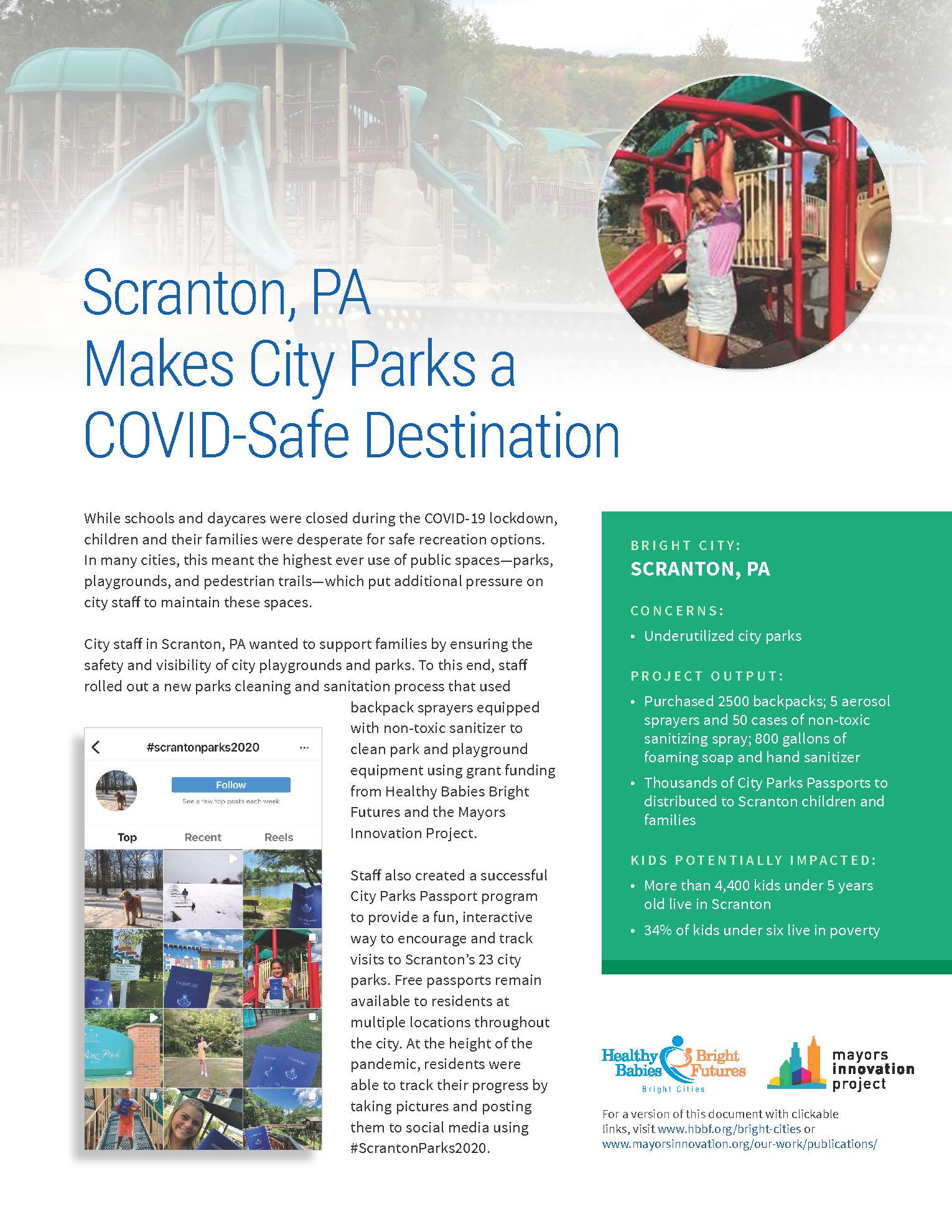
Scranton, PA Makes City Parks a COVID-Safe Destination
Scranton, PA Makes City Parks a COVID-Safe Destination. 2021.
While schools and daycares were closed during the COVID-19 lockdown, children and their families were desperate for safe recreation options. In many cities, this meant the highest ever use of public spaces—parks, playgrounds, and pedestrian trails—which put additional pressure on city staff to maintain these spaces. City staff in Scranton, PA wanted to support families by ensuring the safety and visibility of city playgrounds and parks. To this end, staff rolled out a new parks cleaning and sanitation process that used backpack sprayers equipped with non-toxic sanitizer to clean park and playground equipment using grant funding from Healthy Babies Bright Futures and the Mayors Innovation Project.
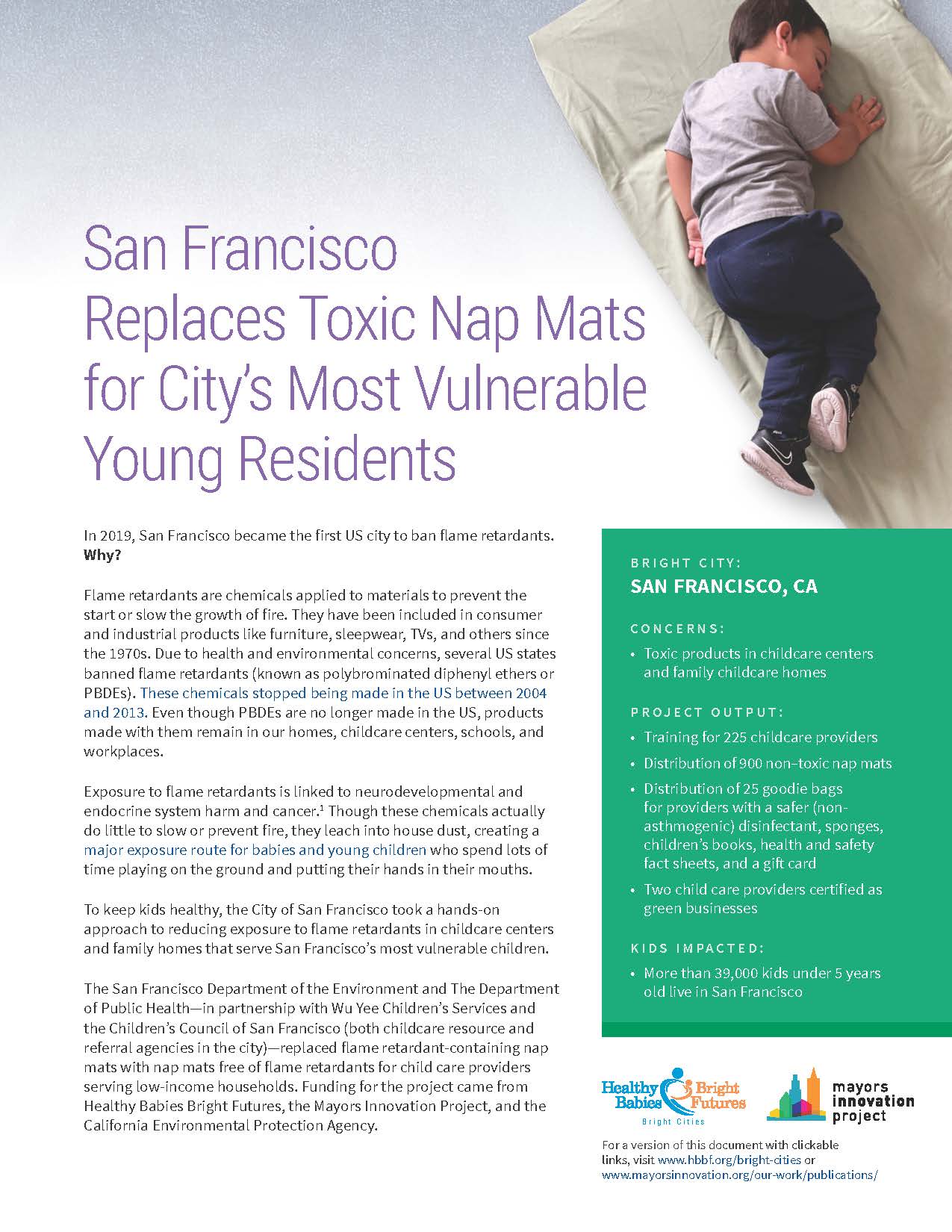
San Francisco Replaces Toxic Nap Mats for City’s Most Vulnerable Young Residents
San Francisco Replaces Toxic Nap Mats for City’s Most Vulnerable Young Residents. 2021.
In 2019, San Francisco became the first US city to ban flame retardants. Why? Flame retardants are chemicals applied to materials to prevent the start or slow the growth of fire. They have been included in consumer and industrial products like furniture, sleepwear, TVs, and others since the 1970s. Due to health and environmental concerns, several US states banned flame retardants (known as polybrominated diphenyl ethers or PBDEs). These chemicals stopped being made in the US between 2004 and 2013. Even though PBDEs are no longer made in the US, products made with them remain in our homes, childcare centers, schools, and workplaces. Exposure to flame retardants is linked to neurodevelopmental and endocrine system harm and cancer.1 Though these chemicals actually do little to slow or prevent fire, they leach into house dust, creating a major exposure route for babies and young children who spend lots of time playing on the ground and putting their hands in their mouths. To keep kids healthy, the City of San Francisco took a hands-on approach to reducing exposure to flame retardants in childcare centers and family homes that serve San Francisco’s most vulnerable children.
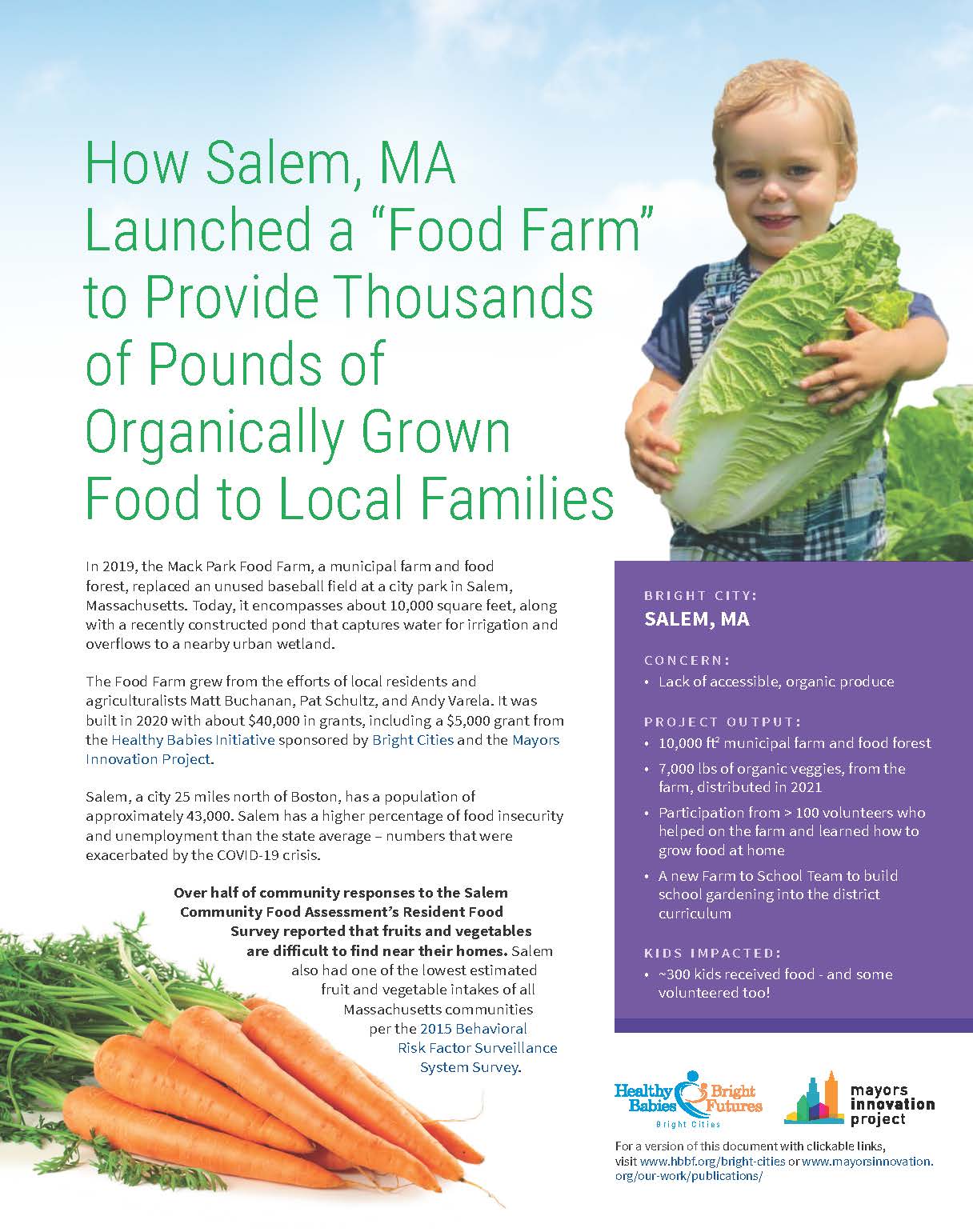
How Salem, MA Launched a “Food Farm” to Provide Thousands of Pounds of Organically Grown Food to Local Families
In 2019, the Mack Park Food Farm, a municipal farm and food forest, replaced an unused baseball field at a city park in Salem, Massachusetts. Today, it encompasses about 10,000 square feet, along with a recently constructed pond that captures water for irrigation and overflows to a nearby urban wetland. The Food Farm grew from the efforts of local residents and agriculturalists Matt Buchanan, Pat Schultz, and Andy Varela. It was built in 2020 with about $40,000 in grants, including a $5,000 grant from the Healthy Babies Initiative sponsored by Bright Cities and the Mayors Innovation Project.
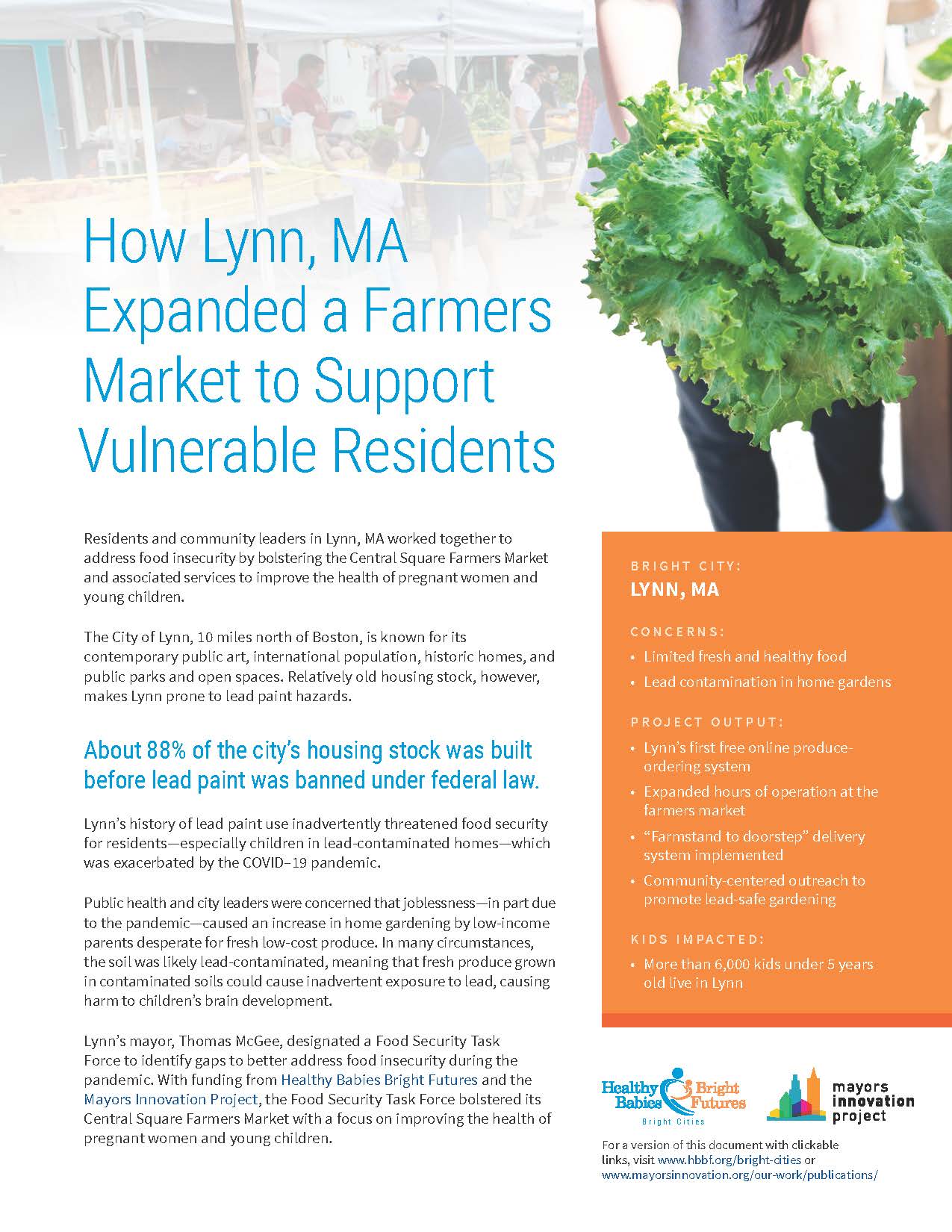
How Lynn, MA Expanded a Farmers Market to Support Vulnerable Residents
How Lynn, MA Expanded a Farmers Market to Support Vulnerable Residents. 2021.
Residents and community leaders in Lynn, MA worked together to address food insecurity by bolstering the Central Square Farmers Market and associated services to improve the health of pregnant women and young children. The City of Lynn, 10 miles north of Boston, is known for its contemporary public art, international population, historic homes, and public parks and open spaces. Relatively old housing stock, however, makes Lynn prone to lead paint hazards.
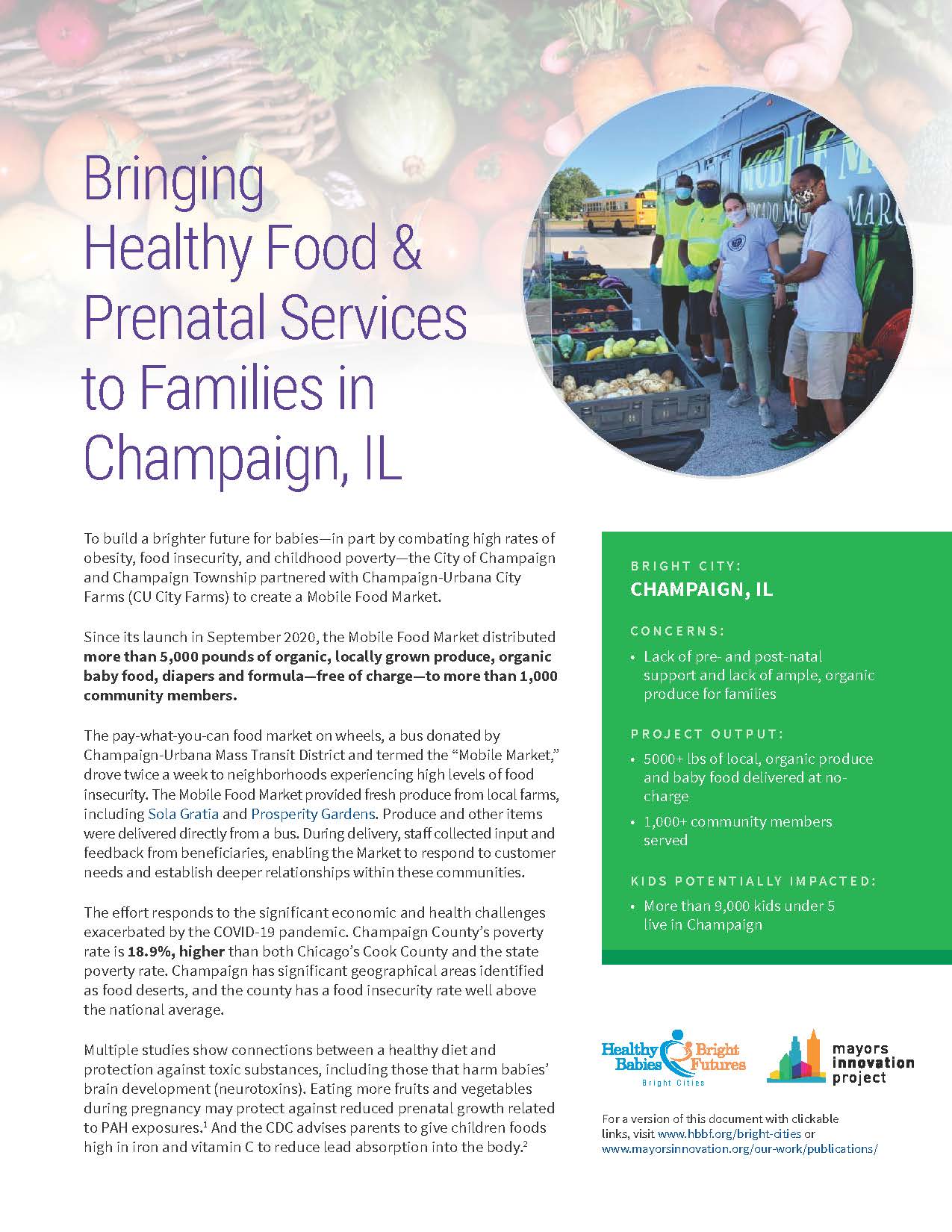
Bringing Healthy Food & Prenatal Services to Families in Champaign, IL
Bringing Healthy Food & Prenatal Services to Families in Champaign, IL. 2021.
To build a brighter future for babies—in part by combating high rates of obesity, food insecurity, and childhood poverty—the City of Champaign and Champaign Township partnered with Champaign-Urbana City Farms (CU City Farms) to create a Mobile Food Market. Since its launch in September 2020, the Mobile Food Market distributed more than 5,000 pounds of organic, locally grown produce, organic baby food, diapers and formula—free of charge—to more than 1,000 community members.
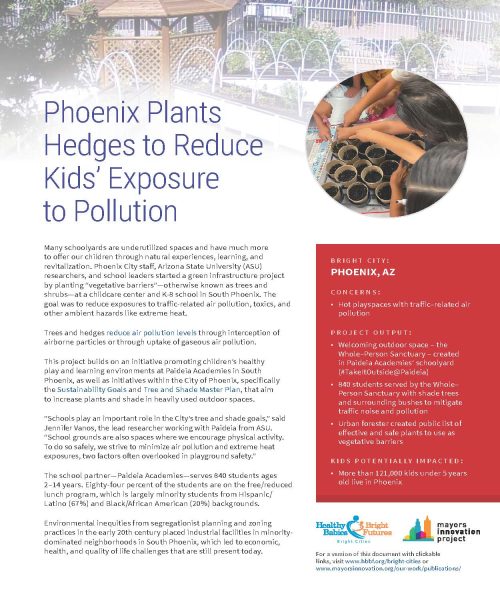
Phoenix Plants Hedges to Reduce Kids’ Exposure to Pollution
Phoenix Plants Hedges to Reduce Kids’ Exposure to Pollution. 2021.
Many schoolyards are underutilized spaces and have much more to offer our children through natural experiences, learning, and revitalization. Phoenix City staff, Arizona State University (ASU) researchers, and school leaders started a green infrastructure project by planting “vegetative barriers”—otherwise known as trees and shrubs—at a childcare center and K-8 school in South Phoenix. The goal was to reduce exposures to traffic-related air pollution, toxics, and other ambient hazards like extreme heat.

Norman, OK Supports Children and Families With Community Access Pop-up Spots
Norman, OK Supports Children and Families With Community Access Pop-up Spots. 2021.
Norman, Oklahoma is home to just under 125,000 residents, as well as the state’s largest university. While the city is full of the usual campus activity, it also includes a wide range of household incomes. COVID-19 increased the number of families with diminished income. Many of these families became eligible for existing social support services, but weren’t aware of available resources. With connection to services, children and families could have additional access to healthy food (via WIC and SNAP programs) and resources to provide transportation and information about reducing neurotoxic exposures at home.
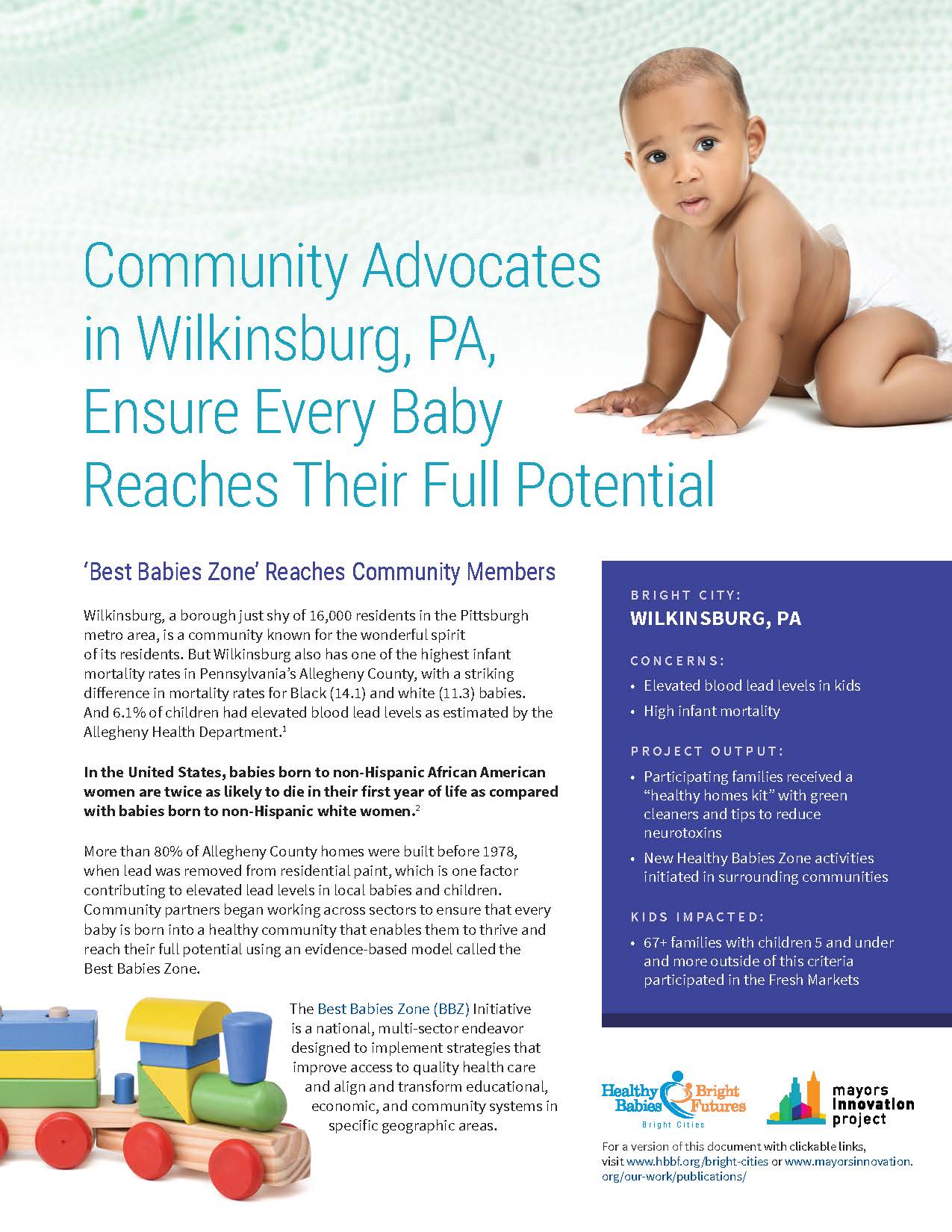
Community Advocates in Wilkinsburg, PA, Ensure Every Baby Reaches Their Full Potential
Community Advocates in Wilkinsburg, PA, Ensure Every Baby Reaches Their Full Potential. 2021.
Wilkinsburg, PA has one of the highest infant mortality rates in Pennsylvania’s Allegheny County, with a striking difference in mortality rates for Black and white babies. And 6.1% of children had elevated blood lead levels as estimated by the Allegheny Health Department. Community partners began working across sectors to ensure that every baby is born into a healthy community that enables them to thrive and reach their full potential using an evidence-based model called the Best Babies Zone.
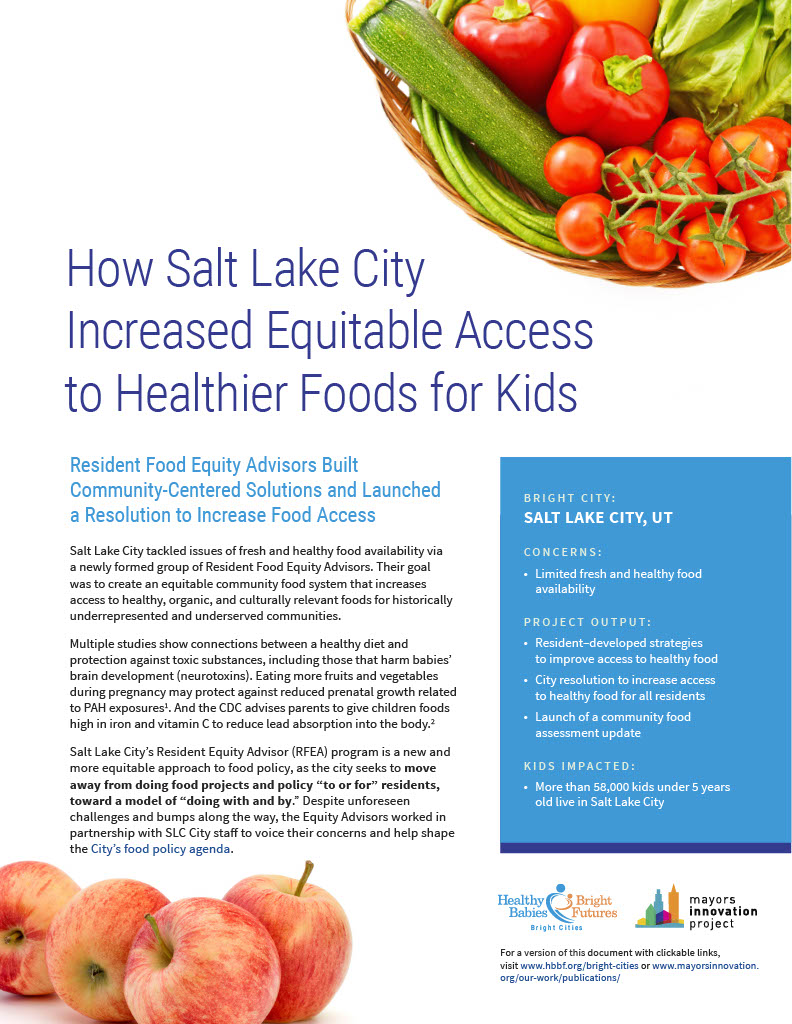
How Salt Lake City Increased Equitable Access to Healthier Foods for Kids
How Salt Lake City Increased Equitable Access to Healthier Foods for Kids. 2021.
Salt Lake City is tackling issues of fresh and healthy food availability via the Resident Food Equity Advisors. Its goal is to help create an equitable community food system that increases access to healthy, organic, and culturally relevant foods for historically underrepresented and underserved communities. Over the course of a year, the Advisors worked in partnership with City staff to voice their concerns and help shape the City’s food policy agenda.
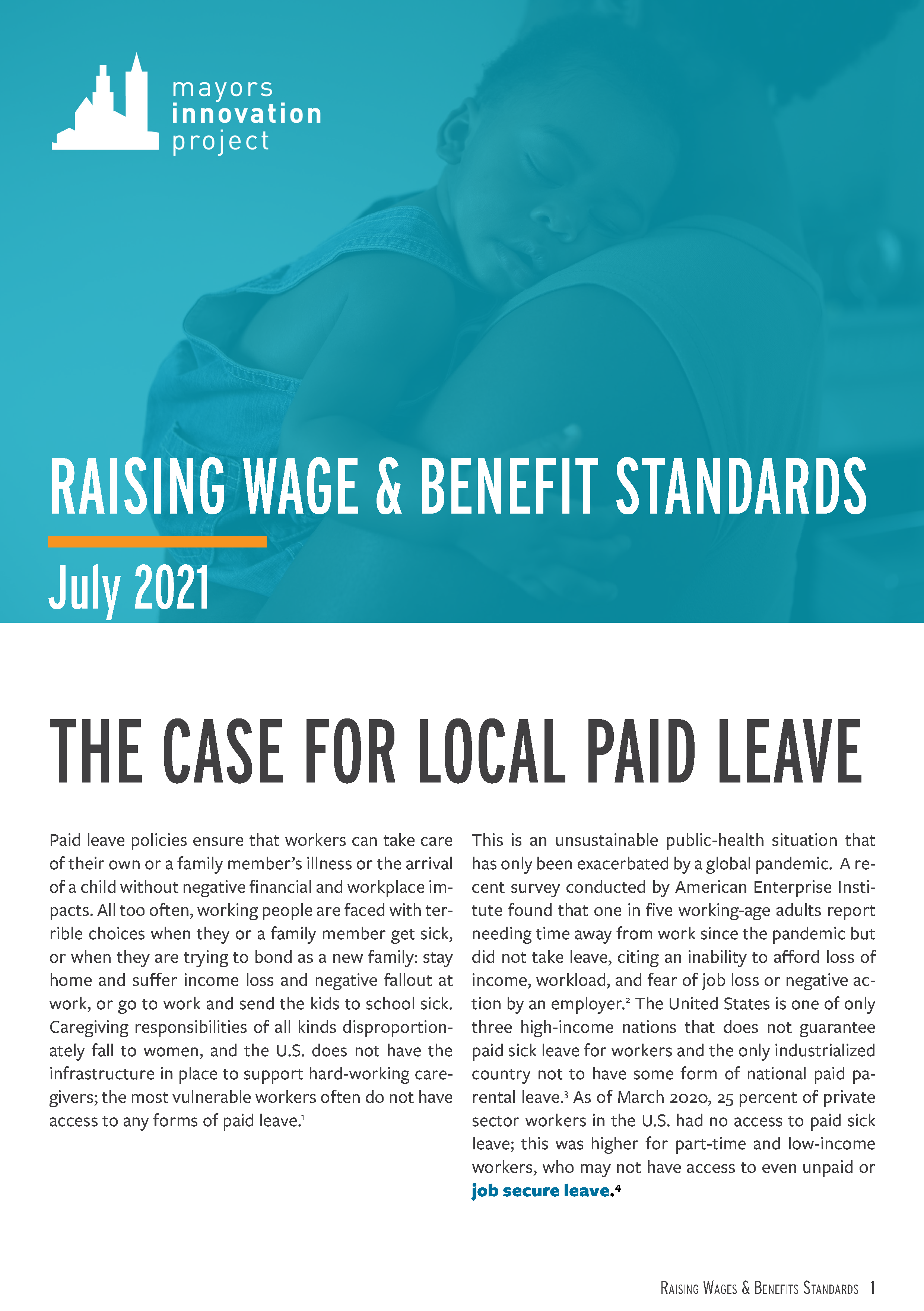
Access to Paid Leave
COVID-19 has created a window of opportunity for advancing paid leave. Amidst an ongoing economic recovery and global health crisis, providing paid leave is a benefit for both businesses and families. Across the board, paid leave policies have found positive benefits. However, without federal support, the burden falls to local governments. How can cities make it happen?
7 Steps to Municipal Resilience & Recovery
7 Steps to Municipal Resilience & Recovery. 2021.
What can municipal governments (counties, cities and towns), still suffering from all the pain and disruption that COVID has brought to their communities and economies, do now to hasten their recovery and build resilience for the future, while also addressing past inequity? Here are seven essential steps to take, all proven, with real-world examples and implementation examples for each, that complement each other and can be done simultaneously.
From Seed to Root: Early-Stage Strategies for Community Wealth Building
From Seed to Root: Early-Stage Strategies for Community Wealth Building.
The U.S. is among the most unequal societies in the world. To address these inequalities, city leaders, including mayors, should play a critical role in community wealth building. This brief profiles three cities, Nashville, Detroit, and Lafayette, LA, on the unique ways that leaders in these cities are building community wealth and their local democratic systems. City leaders, including mayors, are this brief’s intended audience. However, as highlighted in each example, this work requires multiple actors, including community organizers and developers. This brief is useful to anyone committed to equitable economic development in their community.
Setting the Agenda: A Mayor’s Guide to Water Affordability
Setting the Agenda: A Mayor’S Guide to Water Affordability.
Aging water infrastructure systems, climate change, and the general rising cost of urban living mean that access to clean and affordable water is becoming a greater challenge. Cities and water utilities are increasingly faced with a major financial dilemma: increase rates to update infrastructure and price out ratepayers, or keep rates static at the expense of aging and failing infrastructure. At the fulcrum of this choice sits those most vulnerable to increases in rates: low-to-moderate income households, which are disproportionately made up of women and/or people of color.
Actionable Solutions for Public Water Systems
Actionable Solutions for Public Water Systems.
From climate change to outdated infrastructure to lack of federal support, city leaders face more pressure than ever to provide affordable and safe water to residents. Mayors and city leaders need the resources to plan for and improve and maintain public water systems. This report outlines concrete actions a city can take to keep control of its water systems and provides a background to understanding the complexity of public water systems and their current challenges. The solutions for managing robust public systems include topics such as: integrating management approaches for water with other goals; engaging the public in conversations about this valuable resource; promoting affordability of water services; among many more.
Basic Water Utility Management
Basic Water Utility Management.
Access to safe and affordable drinking water is a human right, and it is the duty of the water utility to ensure that this right is protected and upheld. Understanding the different ways water intersects with your city is critical. Basic Water Utility Management provides local leaders with a foundation for understanding their local water systems, including: understanding what a successful water system looks like; getting up to speed on government compliance; identifying infrastructure and maintenance needs; and engaging with community members around water resources.
Paying for Water Systems
Even as the scale of needed investment grows, utilities can develop rate structures, impact fees, and new products or services that generate needed revenue fairly. This report is a primer on getting started with financing water systems, including: assessing where the largest costs are incurred and where borrowing is most extensive; understanding your city’s specific water utility structure and financial status; building a relationship with your water utility manager/CEO(s); and reaching out to and growing relationships with community leaders across a range of neighborhoods and interests, and asking questions about needs and water affordability.
Reducing Carbon Risk & Investing in Local Economic Strength
Reducing Carbon Risk & Investing in Local Economic Strength.
Climate change poses a risk to communities and their investments. There is a growing toolbox of measures cities can take to combat climate change. One of these tools, divestment from fossil fuels, is ethical, viable, and a moral imperative. Successful divest/invest strategies are a matter of political will. Steps a city can take: determine if they have funds that should be divested; reinvest the capital moved from fossil fuel stocks to a Green Bank or Revolving Loan Fund; identify what opportunities there are to attract “fossil free” investments to sustainable projects via green bonds or other mechanisms; ensure that any jobs created through this process are quality jobs.
Leading with Transit
Transit service provides a critical link for people in cities. Rather than throw up their hands in the face of falling ridership and revenue streams, cities need to invest in this critical resource. Doing so can provide a wealth of co-benefits that cities care about: the environmental benefits of reducing congestion and car travel; economic benefits of connecting people and jobs; and reducing inequities by providing better access to historically disadvantaged people and neighborhoods. Leading on Transit, describes how cities, in partnership with their transit agencies, public, and other agencies and institutions, can work to enhance transit.
Modernizing Mitigation
Traditional Transportation Demand Management (TDM) strategies are increasingly used by large employers and building owners to encourage the use of alternatives to driving – things like providing bus passes, bike share, and affordable carpooling. But most existing best practices overlook the role of local government decision makers, whose decisions on policy affecting local transportation options, planning and regulation of land use, structure and enforcement of fees, taxes and other financial signals can play a big role in increasing or decreasing vehicle demand.
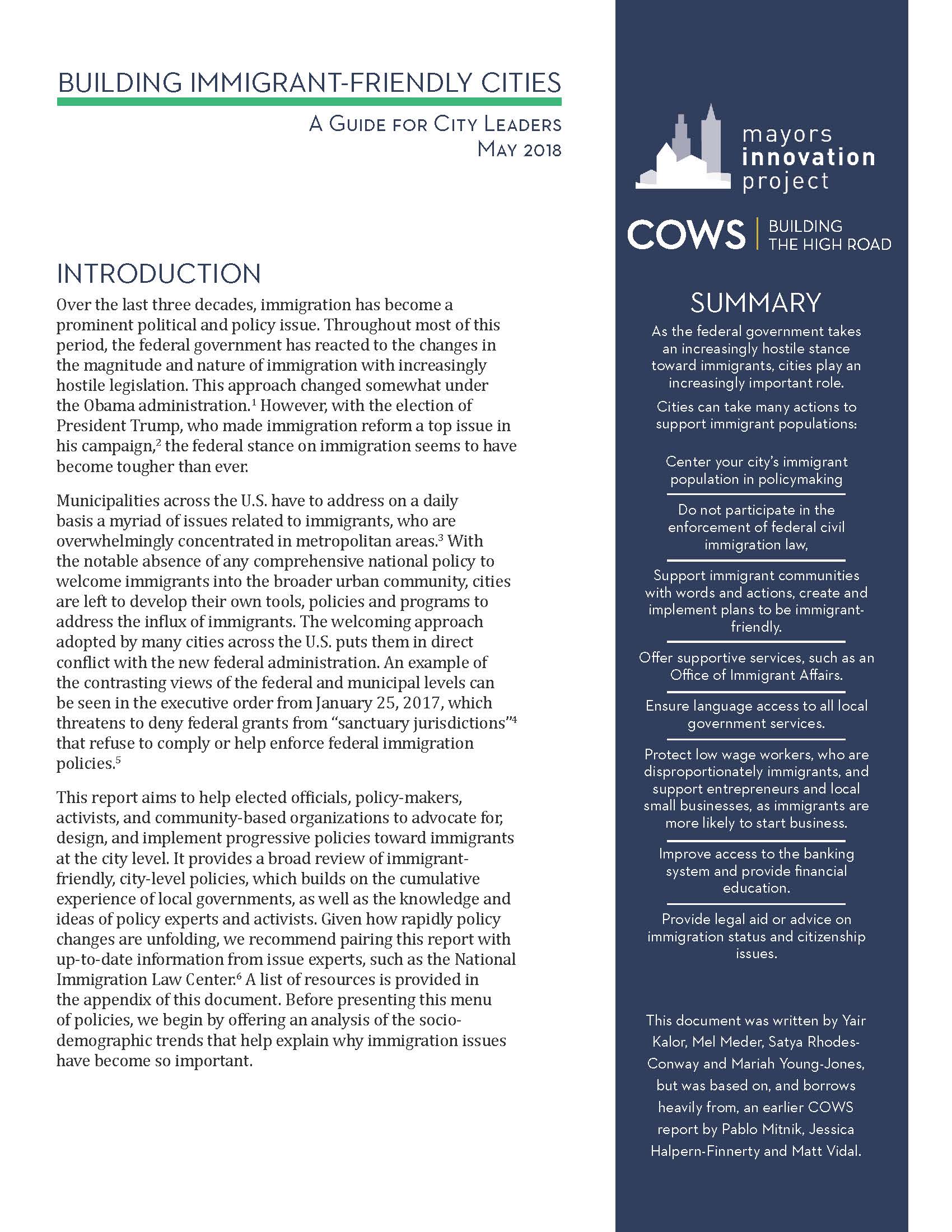
Building Immigrant-friendly Cities: A Guide for City Leaders
Building Immigrant-Friendly Cities: A Guide for City Leaders.
As the federal government takes an increasingly hostile stance on immigration over the last 30 years, immigrant communities have become more vulnerable than ever. With the absence of a comprehensive national policy, cities must develop policies and programs to address the influx of immigrants. Municipalities across the U.S. have to address on a daily basis a myriad of issues related to immigrants, who are overwhelmingly concentrated in metropolitan areas. This report aims to help elected officials, policy-makers, activists, and community-based organizations advocate for, design, and implement progressive policies toward immigrants at the city level.
Local Policies for Greenhouse Gas Reduction
Local Policies for Greenhouse Gas Reduction.
President Donald Trump’s announced withdrawal of the U.S. from the Paris Climate Agreement is a clear shirking of responsibility on behalf of the federal government, but across the country, organizers, activists, mayors, governors and others are only increasing their commitment to the principles of the agreement. Mayors and their cities have many ways to contribute to sound climate policy and carbon reduction. Here we introduce some of the key ways that cities can make a difference in the face of federal inaction.
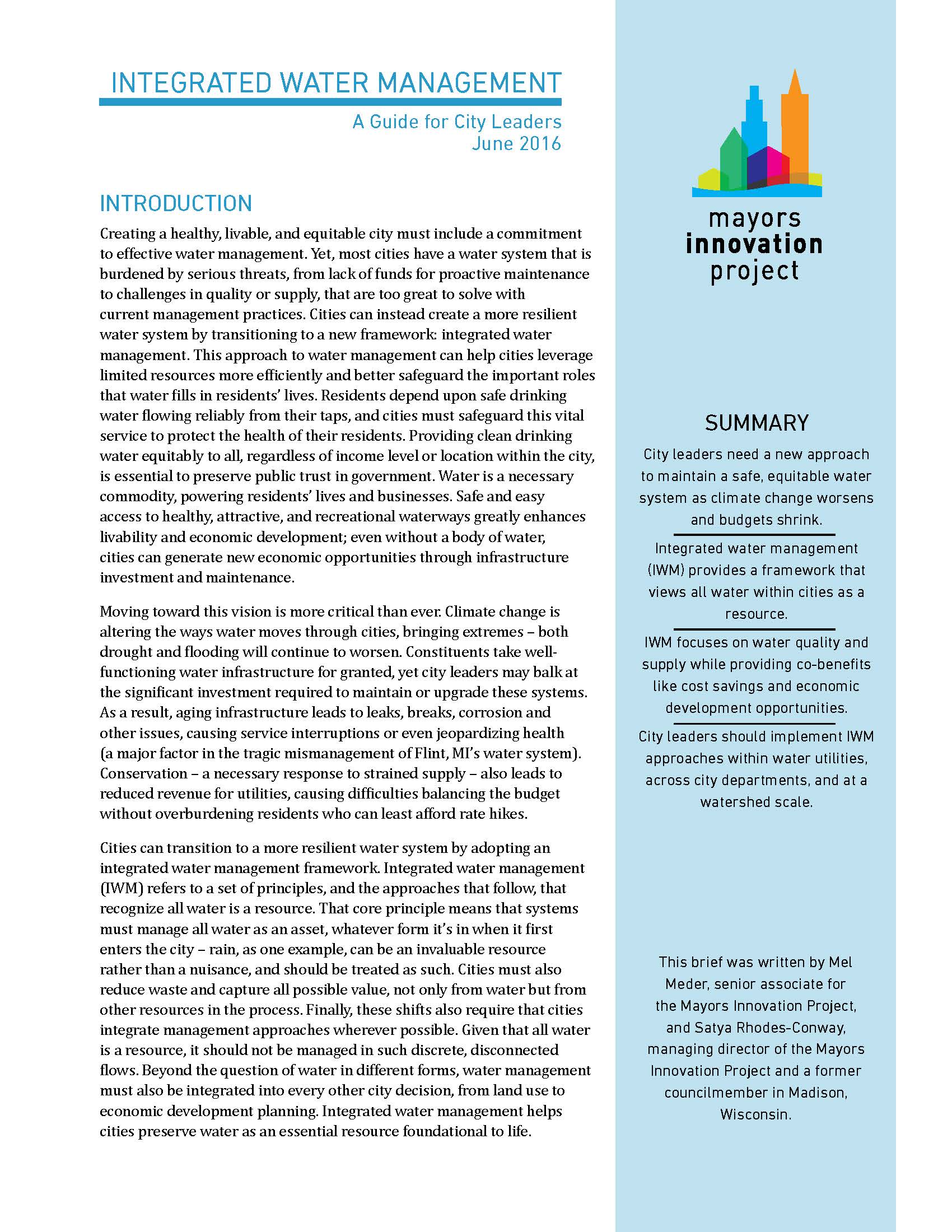
Integrated Water Management: A Guide for City Leaders
Integrated Water Management: A Guide for City Leaders.
Integrated water management (IWM) offers a framework for managing all water within cities as a resource, reducing waste while capturing value, and seeking to integrate water into other city planning. The benefits of IWM include better resource management, development opportunities, and creative funding to improved recreational areas. This report provides an overview of the potential for IWM in cities from the big-picture framework down to examples of tools used by cities on the ground. IWM includes tools like protection of natural lands near waterways, capture of rain as a resource, an end to “waste” water, and planning for climate resilience.
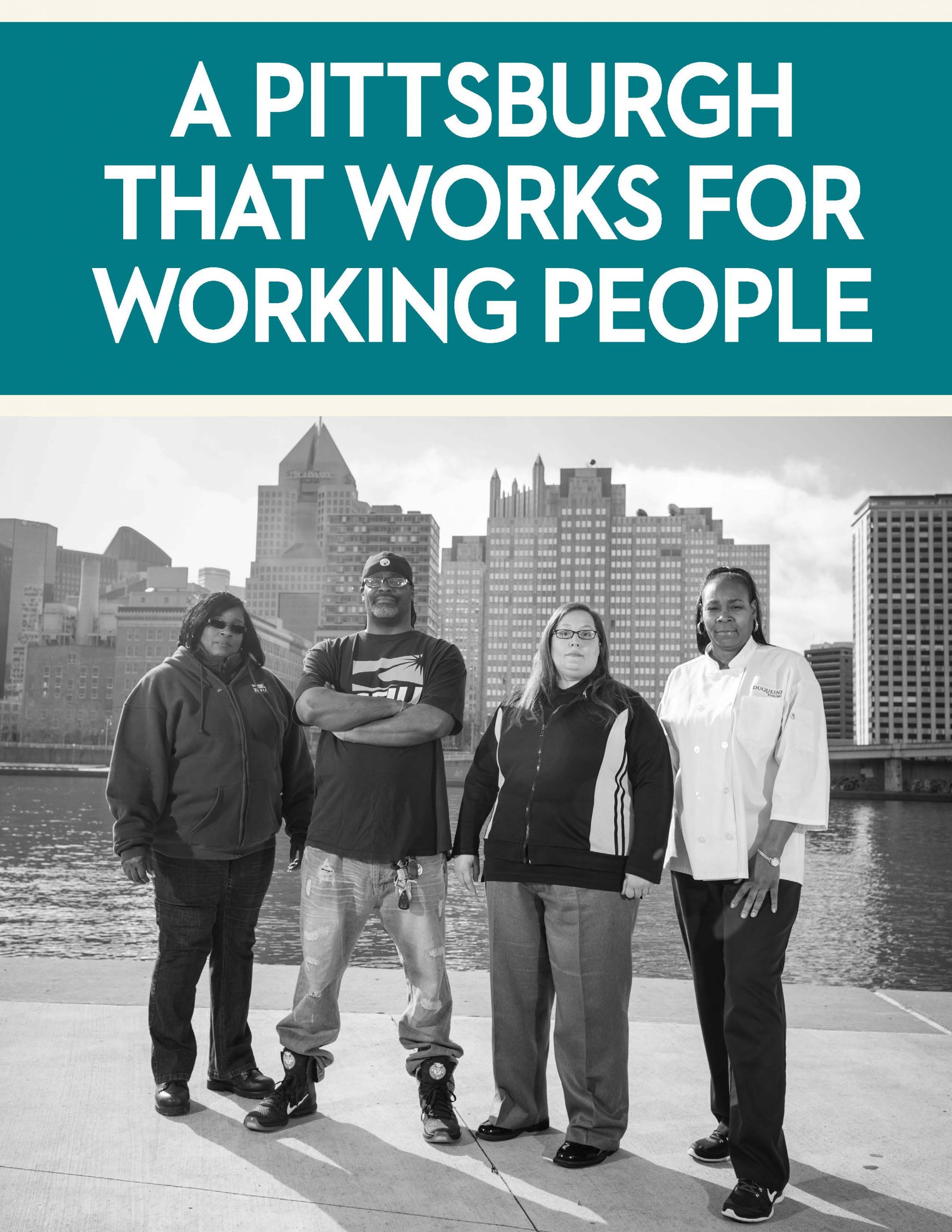
A Pittsburgh that Works for Working People
A Pittsburgh That Works for Working People.
The vision presented in this report is one in which Pittsburgh is known as the city that rebuilt its economy into one of broadly shared prosperity and strong labor standards; with a housing market that meets the needs of long-term residents while also welcoming newcomers; that offers equitable, accessible and safe transportation choices that connect all residents to employment and other critical destinations; and that prioritizes strong community-police relations with historically marginalized communities of color and new immigrants to ensure Pittsburgh is a most livable city for all residents.
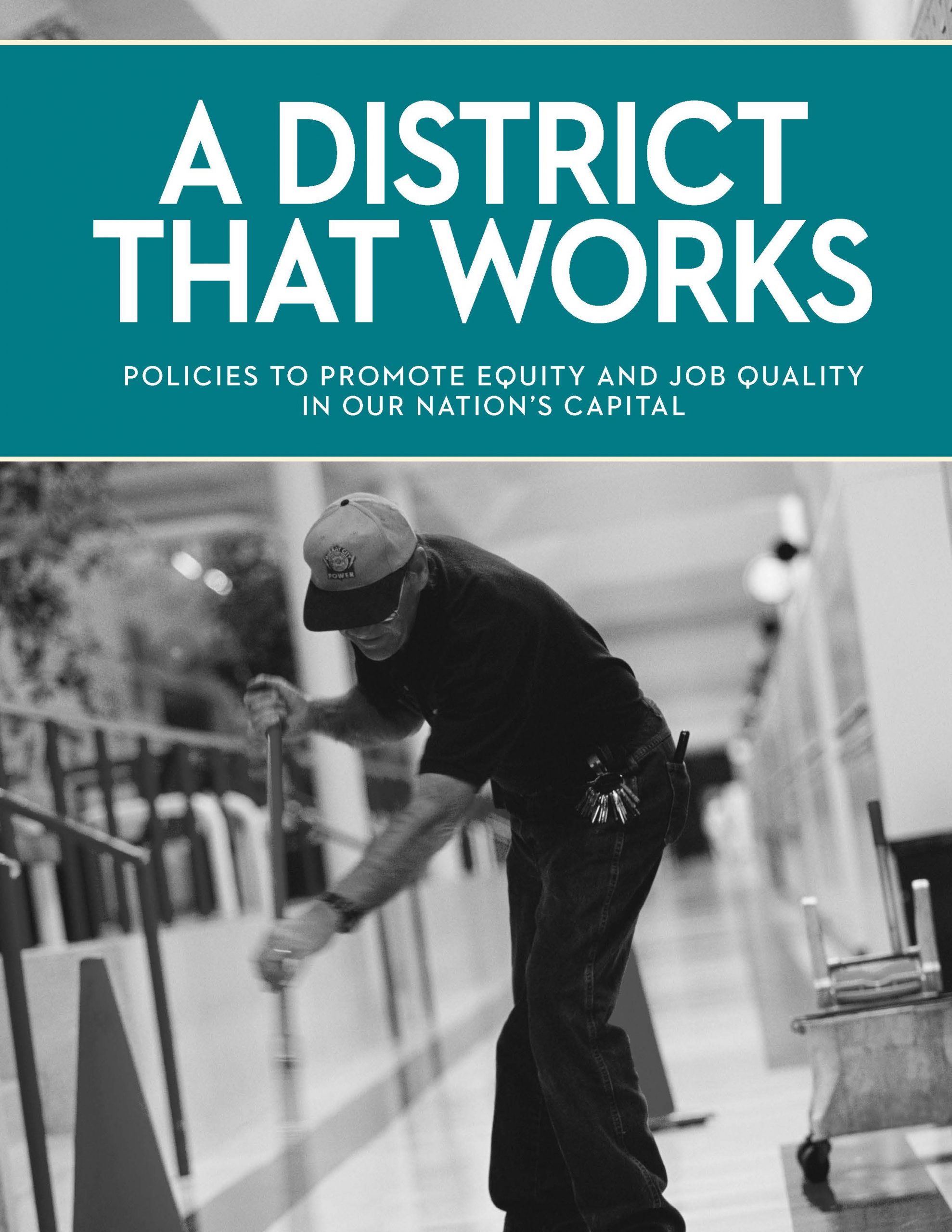
A District That Works: Policies to Promote Equity and Job Quality in our Nation’s Capital
A District That Works: Policies to Promote Equity and Job Quality in Our Nation’S Capital.
The District of Columbia is going through a period of great transformation. While it has successfully strengthened its fiscal health and its economy and population have grown, its prosperity has not been evenly distributed. However, it is not too late for the District to adopt measures that strengthen low income communities and communities of color and push back against the trend of growing inequality. The new administration has a fresh opportunity to tackle these challenges. It will be essential that key leaders in the administration are driven by a strong vision for how to make the District work for all of its residents.
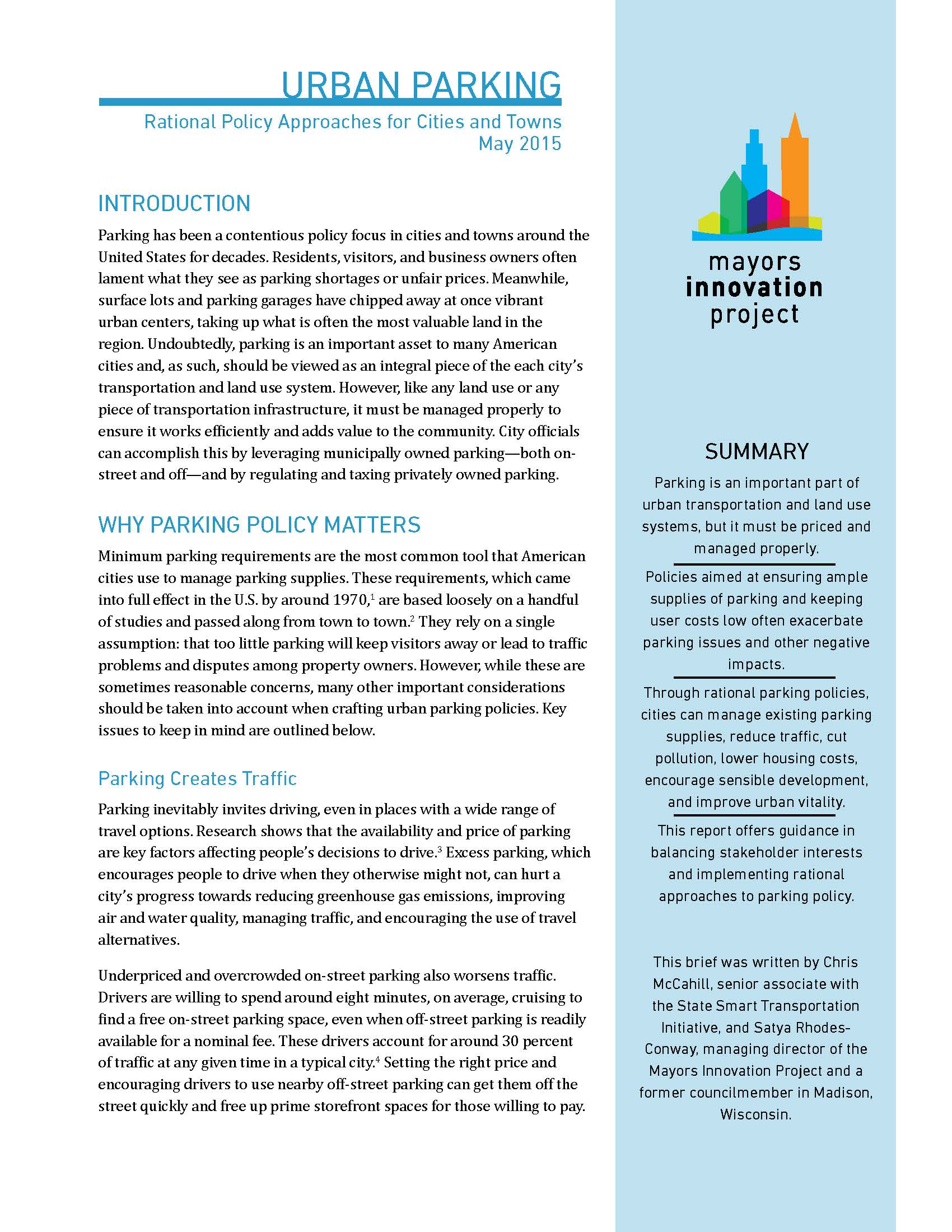
Urban Parking
Undoubtedly, parking is an important asset to many American cities and, as such, should be viewed as an integral piece of the each city’s transportation and land use system. However, like any land use or any piece of transportation infrastructure, it must be managed properly to ensure it works efficiently and adds value to the community. City officials can accomplish this by leveraging municipally owned parking—both onstreet and off—and by regulating and taxing privately owned parking.
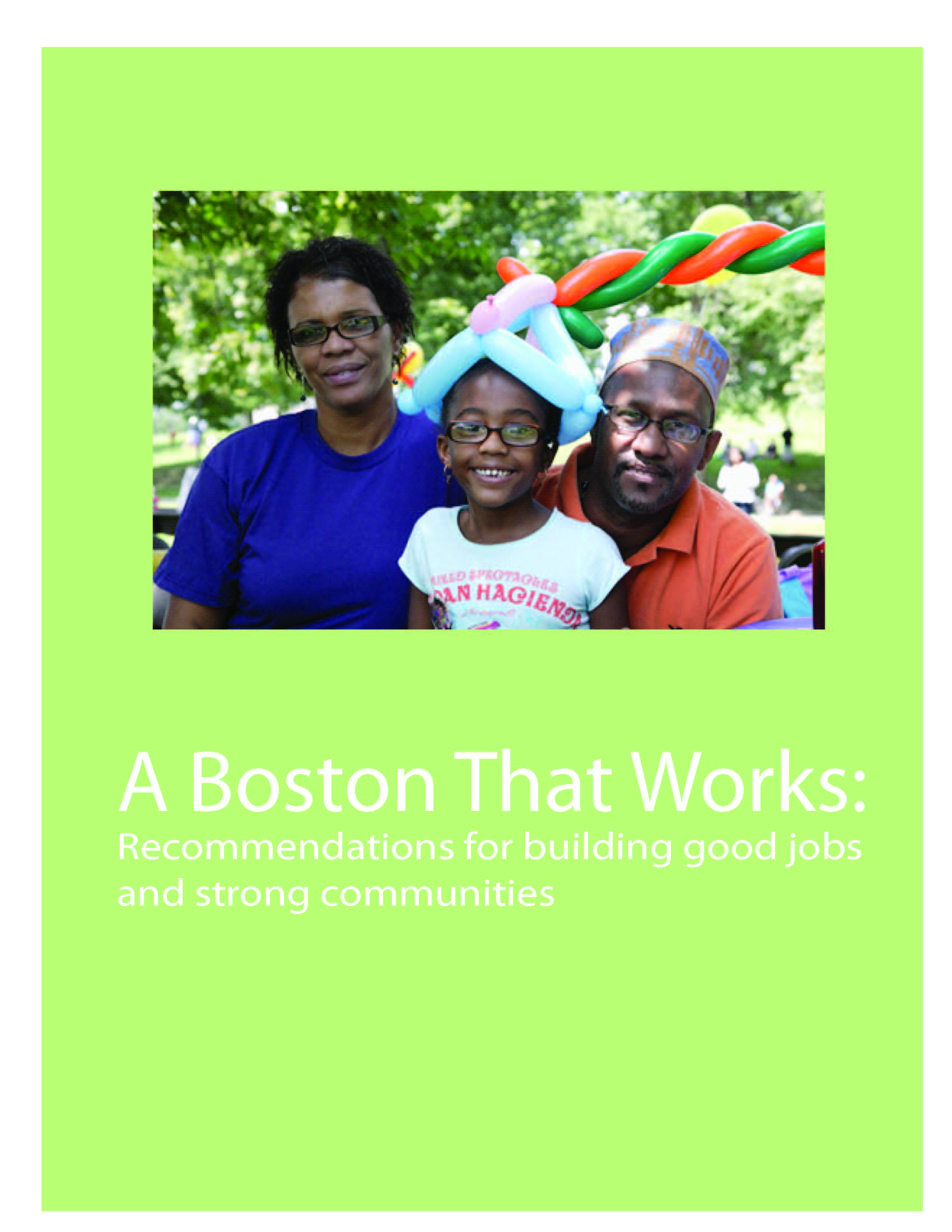
A Boston That Works
Nearly one in four Boston families lives in poverty and incomes in the Greater Boston area are more unequally distributed than in the vast majority of other metro areas around the country. The good news is that the City has a number of important tools that can be engaged to address these problems. However, in order to maximize its effectiveness, the City will have to re-focus and re-organize its approach to economic development. Critically, the City must make combatting poverty and inequality a core priority in all of its programs. Moreover, the City should adopt a broader and more proactive vision of economic development and reorganize programs and structures accordingly. This report, co-written with SEIU 32BJ, identifies five key ways in which the City can re-focus and re-organize its programs and provides a number of specific recommendations of steps the City should take.
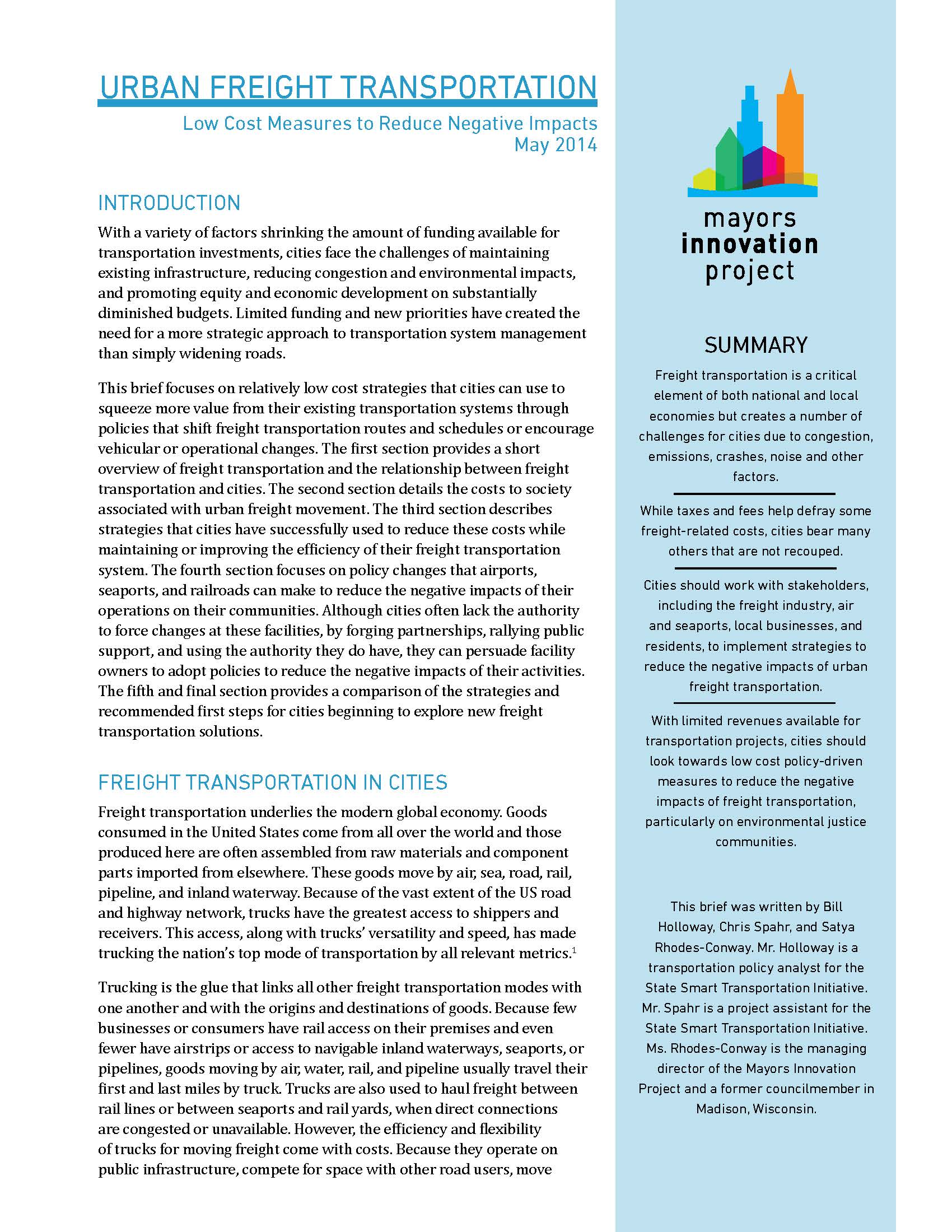
Urban Freight Transportation: Low Cost Measures to Reduce Negative Impacts
Urban Freight Transportation: Low Cost Measures to Reduce Negative Impacts.
Freight transportation is a critical element of both our national and local economies. Yet, it creates a number of challenges for cities due to congestion, emissions, crashes, noise and other factors. This report provides cities with low cost policy-driven measures to reduce the negative impacts of freight transportation. Increasing the efficiency of freight movement and addressing the social costs and environmental justice issues of freight transportation are not mutually exclusive. The strategies identified in this report can help cities meet their transportation challenges in the years ahead while promoting just, healthy, and sustainable freight practices.
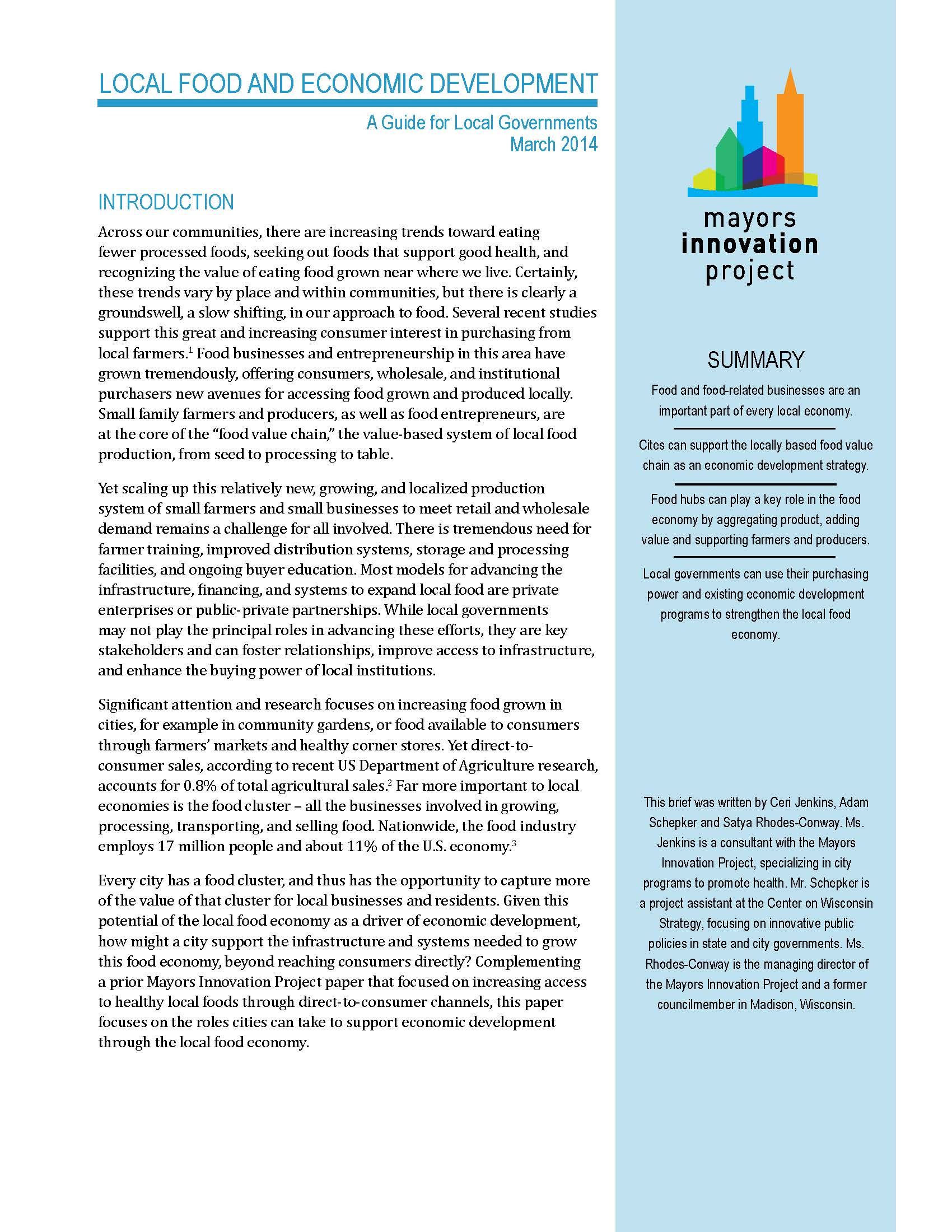
Local Food and Economic Development: A Guide for Local Governments
Local Food and Economic Development: A Guide for Local Governments.
Every city has a food economy and most have at least the beginnings of a local food value chain. This means that every city has an opportunity to increase local economic activity, create jobs, and promote healthy, local food by helping local businesses to capture more of this market. Cities should include local food as part of their economic development efforts, and this paper will help them do that. Nationally, the trend is toward local food – cities should take advantage of this.
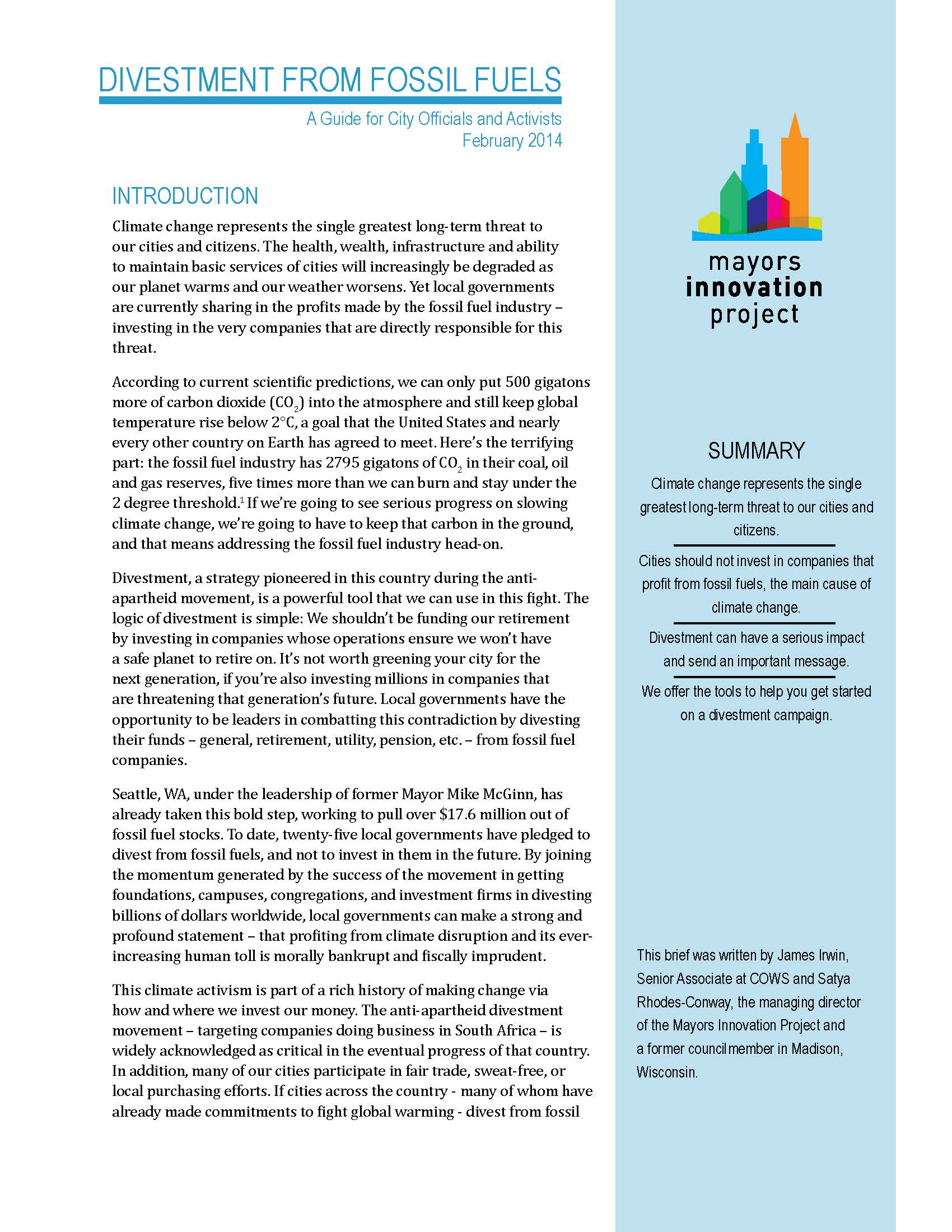
Divestment from Fossil Fuels: A Guide for City Officials and Activists
Divestment from Fossil Fuels: A Guide for City Officials and Activists.
The logic of divestment is simple: we shouldn’t be funding our retirement by investing in companies whose operations ensure we won’t have a safe planet to retire on. Local governments have the opportunity to be leaders in combating this contradiction by divesting their funds from fossil fuel companies. MIP in partnership with Bill McKibben and 350.org, is working to support the local government fossil fuel divestment movement. Building on the example set by Mayor McGinn of Seattle, we’re removing municipal funds from fossil fuel investments, and working with pension funds to do the same.
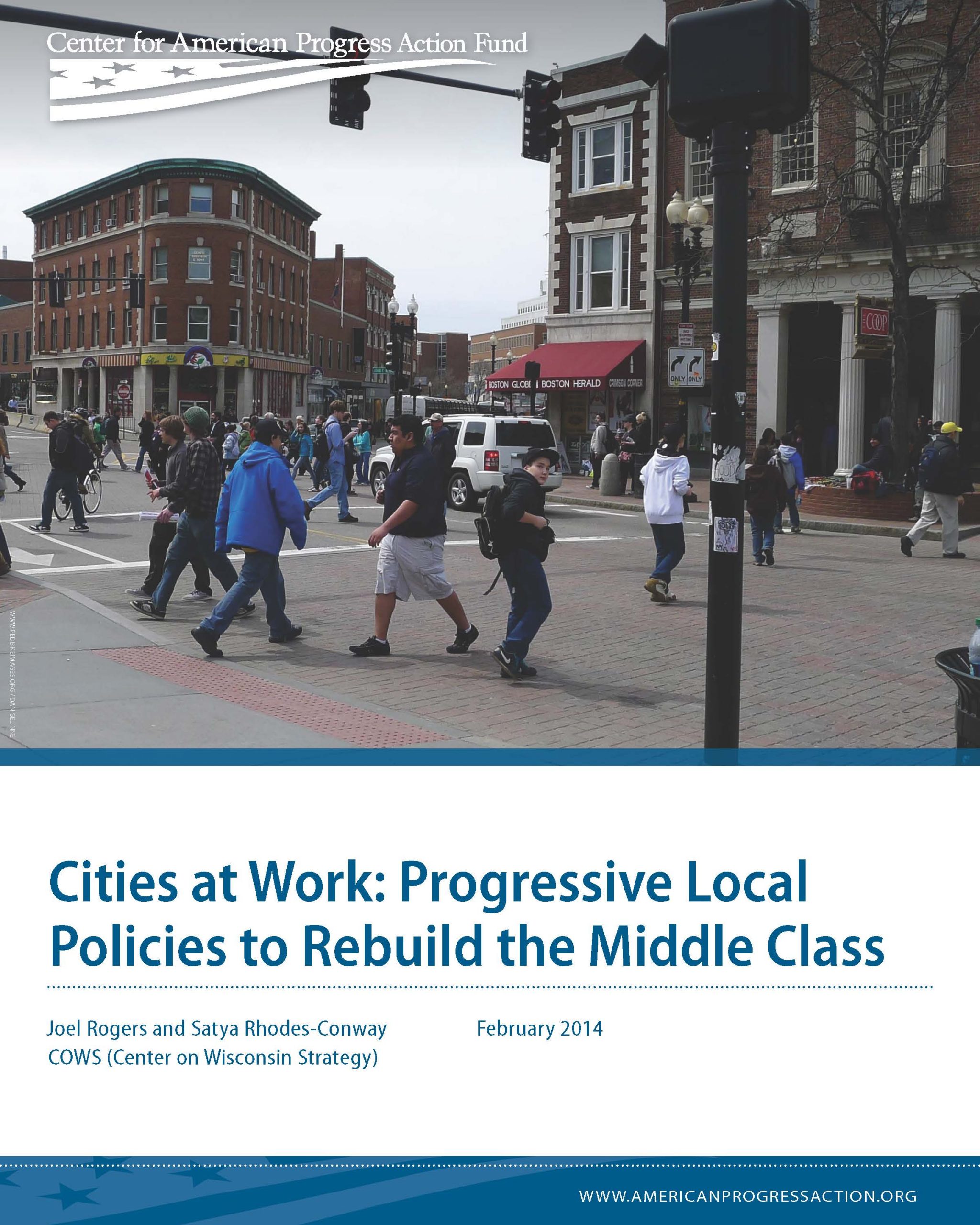
Cities at Work: Progressive Local Policies to Rebuild the Middle Class
Cities at Work: Progressive Local Policies to Rebuild the Middle Class.
This report is based on the practical experience and struggle of elected officials across the country to move their communities onto the “high road” of shared prosperity, environmental sustainability, and efficient democratic government. Its goal is to arm progressive local elected leaders and advocates with a range of effective policies that, if adopted, would make a significant difference in getting on that high road. They will be able to use better democratic organization to add value, reduce waste, and capture and share locally the great benefits of doing both. Report summary.
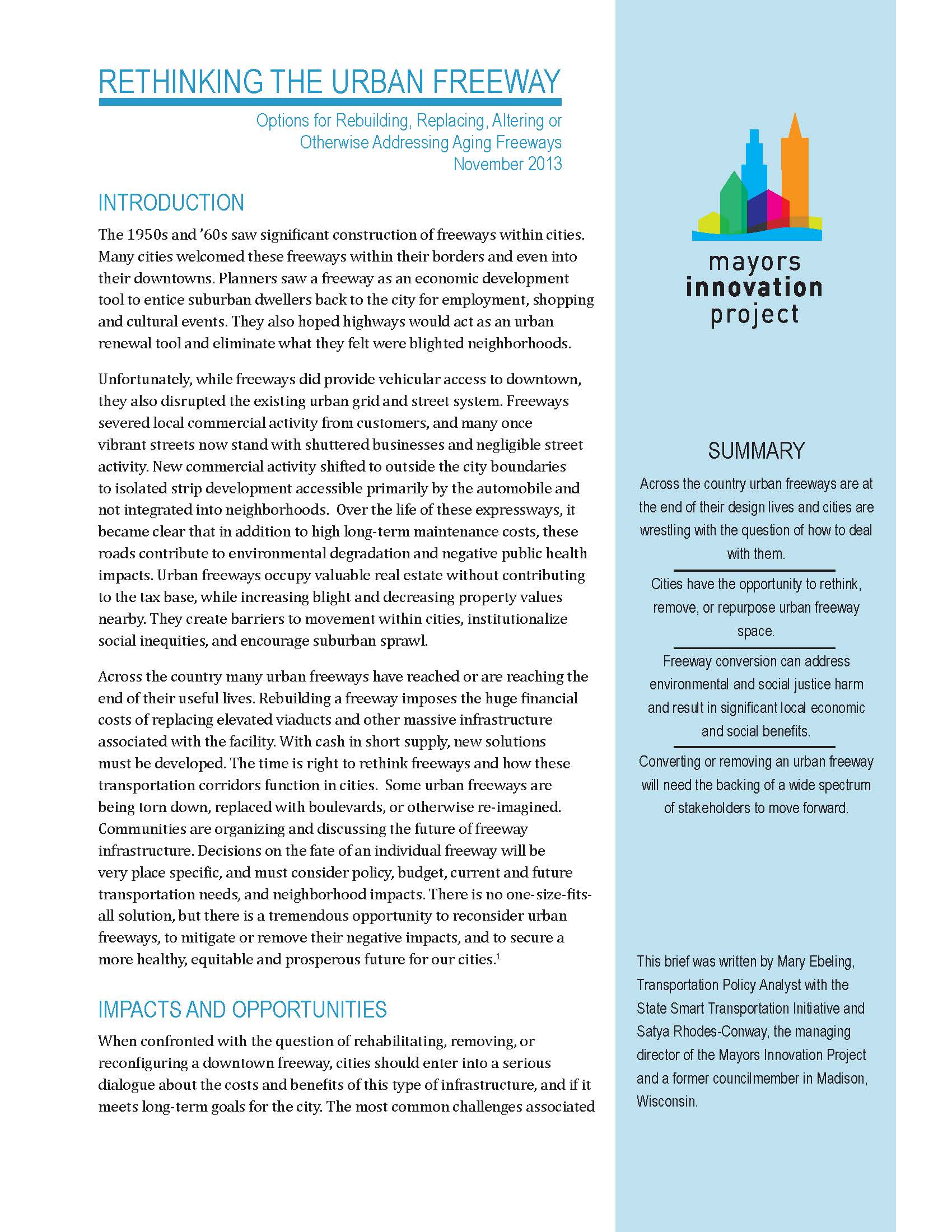
Re-Thinking the Urban Freeway: Options for Rebuilding, Replacing, Altering or Otherwise Addressing Aging Freeways
Across the country, urban freeways are at the end of their design lives, and cities are wrestling with the question of how to deal with them. Cities have the opportunity to rethink, remove, or repurpose urban freeway space, which can address environmental and social justice harm and result in significant local economic and social benefits. This report provides cities with best practices and solutions from across the country, to help cities mitigate negative freeway impacts and secure a healthy and more prosperous future.
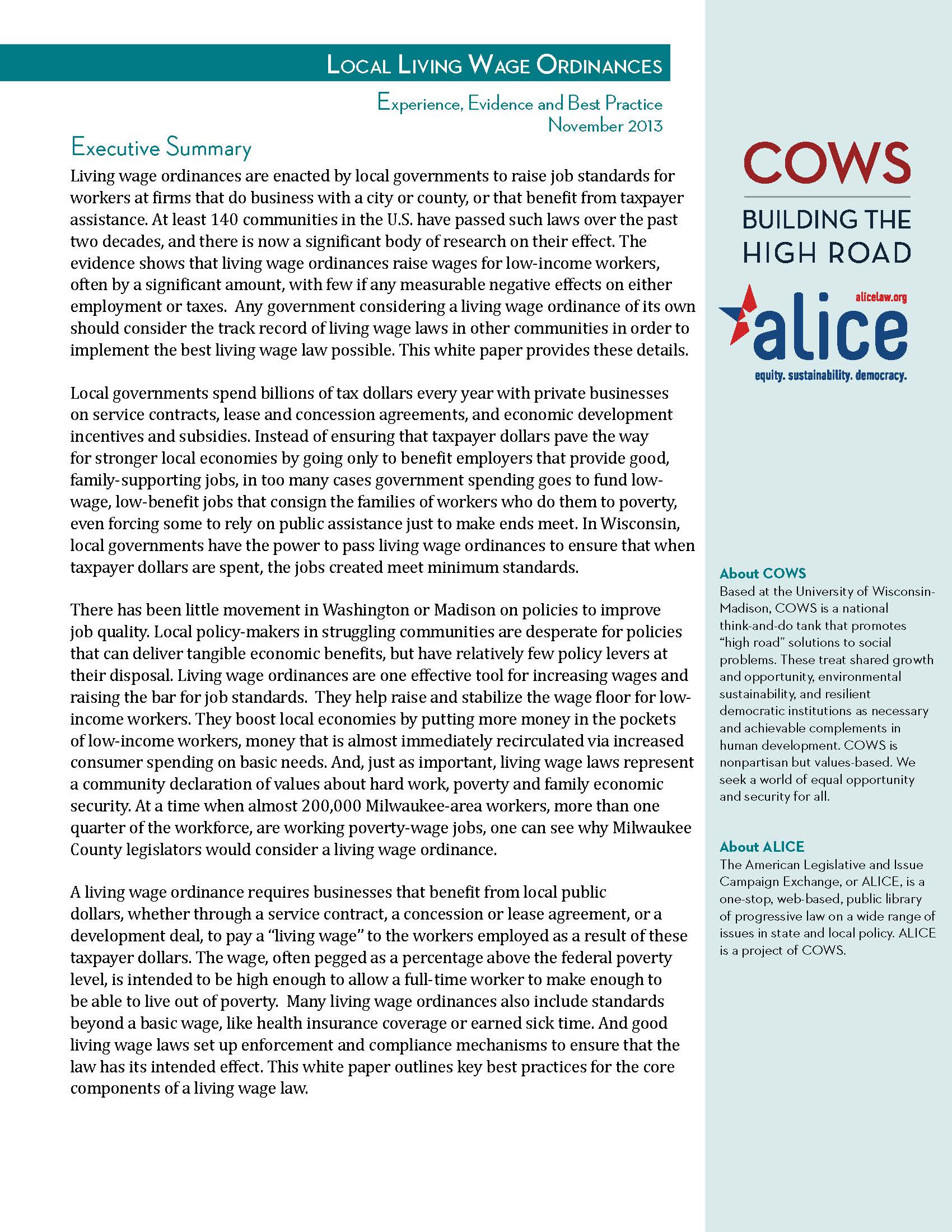
Local Living Wage Ordinances: Experience, Evidence and Best Practices
Local Living Wage Ordinances: Experience, Evidence and Best Practices.
Living wage ordinances raise job standards for workers at firms that do business with a city or county or that benefit from taxpayer assistance. At least 140 communities in the U.S. have passed such laws over the past two decades, and there is now a significant body of research on their effect. The evidence shows that living wage ordinances raise wages for low-income workers, often by a significant amount, with few if any measurable negative effects on either employment or taxes. Cities should consider the track record of living wage laws in other communities in order to implement the best living wage law possible. Written and produced by our partner projects, COWS and ALICE.
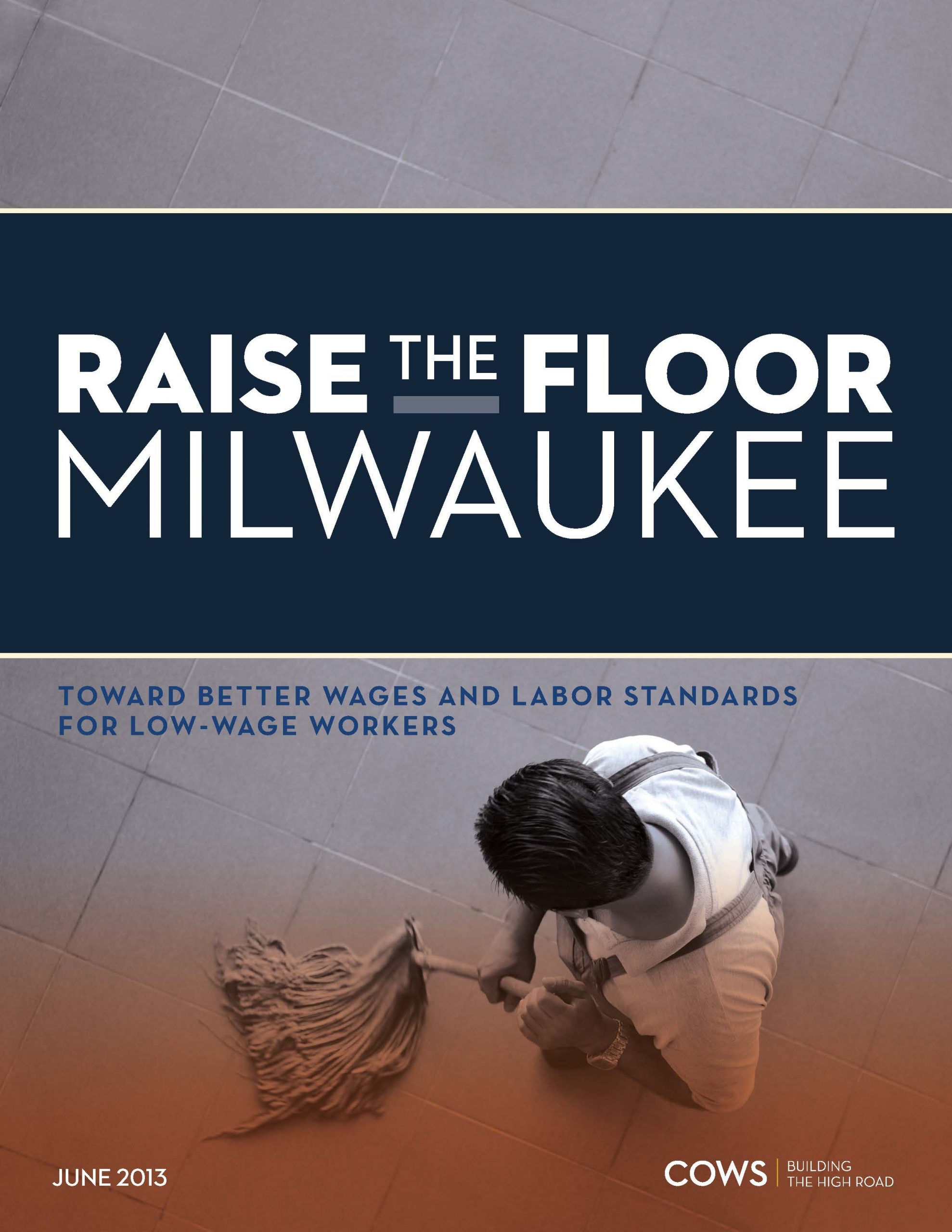
Raise the Floor Milwaukee
This report highlights how raising the low-wage floor improves quality of life for the 100,000 workers in poverty-wage jobs in the city, and for a roughly equal number of poverty-wage workers in the suburban counties around city. Long term decline was made more brutal by the Great Recession, leaving workers at the mercy of a dramatic shift from manufacturing into services, declining unionization, and falling job quality. Evidence of the economic crisis abounds, yet Milwaukee’s problems — including racial disparity and residential segregation, child poverty, crime and incarceration, catastrophic drop-out rates, especially for African Americans and Hispanics — are not inevitable.
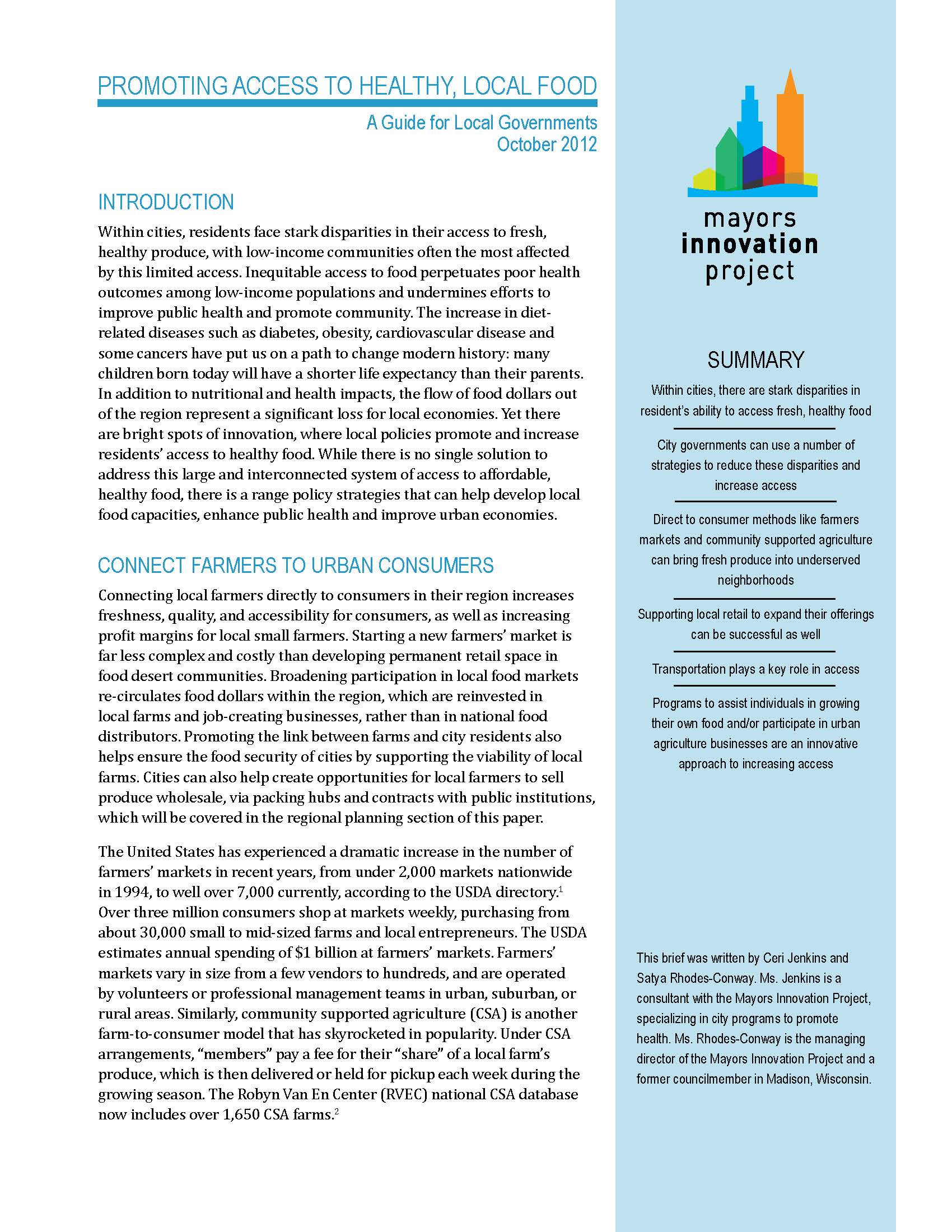
Promoting Access to Healthy Local Food: A Guide for Local Governments
Promoting Access to Healthy Local Food: A Guide for Local Governments.
Inequitable access to food perpetuates poor health outcomes among low-income populations and undermines efforts to improve public health and promote community. The increase in diet-related diseases such as diabetes, obesity, cardiovascular disease, and some cancers have put us on a path to change modern history: many children born today will have a shorter life expectancy than their parents. In addition to nutritional and health impacts, the flow of food dollars out of some regions represents a significant loss for local economies. This policy brief looks at bright spots of innovation, where local policies promote and increase residents’ access to healthy food.
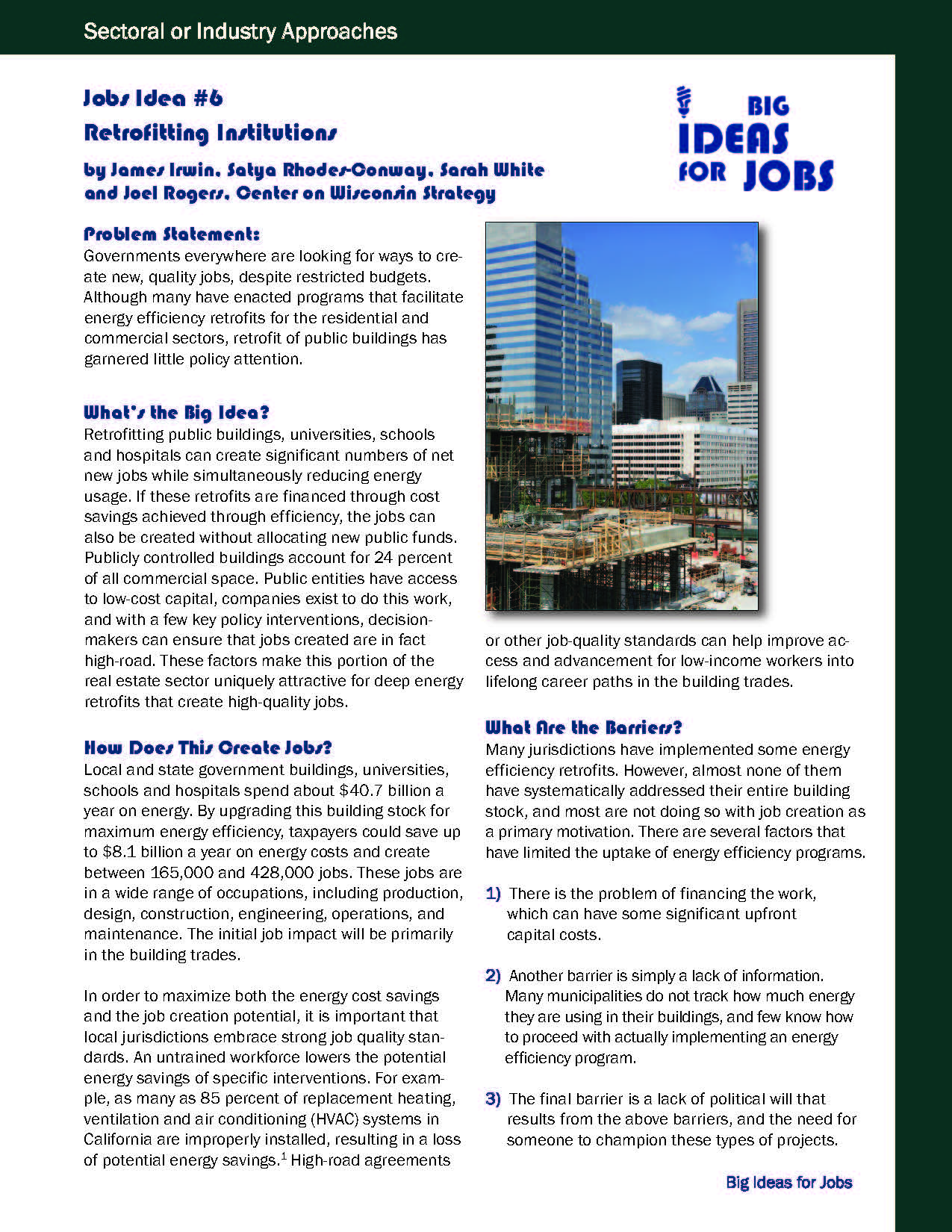
Jobs Idea #6: Retrofitting Institutions
Jobs Idea #6: Retrofitting Institutions.
Governments everywhere are looking for ways to create new, quality jobs, despite restricted budgets. Although many have enacted programs that facilitate energy efficiency retrofits for the residential and commercial sectors, retrofit of public buildings has garnered little policy attention.
Cities and Immigration: Local Policies for Immigrant-Friendly Cities
Cities and Immigration: Local Policies for Immigrant-Friendly Cities.
This report aims at helping individuals and organizations advocate for, design, and implement progressive policies toward immigrants at the city level as well as address, with immigrant-friendly, city level policies, the problems that large inflows of immigrants sometimes generate for the communities receiving them. These goals have become particularly important given the recent failures of comprehensive immigration reform initiatives at the federal level.
Cities and Jobs: Local Strategies for Improving Job Quality and Access
Cities and Jobs: Local Strategies for Improving Job Quality and Access.
What can cities do to improve the quality of jobs? How can cities boost the access of the disadvantaged to the good jobs available in their jurisdictions? Building from policy innovations and experiences from all around the country, we offer here a menu of city policies aimed at improving job quality and redistributing job opportunities in favor of the disadvantaged.
New Energy for Cities: Energy-Saving & Job Creation Policies for Local Governments
New Energy for Cities: Energy-Saving & Job Creation Policies for Local Governments.
In this report, we lay out the Apollo Alliance’s Four-Part Plan for how cities can embrace a clean energy future: invest in renewable power; create high-performance buildings; drive toward energy independence; and build high-performance cities.